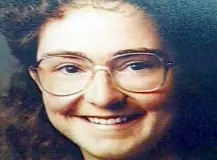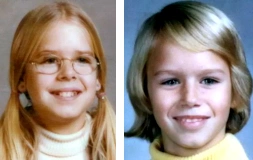
The Man With the Tape Recorder: The Disappearance of the Lyon Sisters
Sheila Mary Lyon was 12 years old and her younger sister Katherine Mary Lyon was 10 when the two of them left their family's home on Plyers Mill Road in Kensington, Maryland, on March 25, 1975, and never returned. It was the second day of spring vacation, an unremarkable Tuesday the girls planned to spend browsing an Easter display and meeting friends at the nearby Wheaton Plaza shopping center. What actually happened to them that afternoon would remain entirely unknown for nearly four decades, until a cold case detective noticed something in an old file that everyone before him had missed, unraveling a confession involving a carnival worker, his own father and uncle, a padlocked basement, and a rural Virginia mountainside where investigators now believe the girls' remains were burned and buried.
A Close, Ordinary Family
Sheila, born March 30, 1962, and Katherine, born March 29, 1964, were the daughters of John and Mary Lyon. Their father was a well known radio personality at WMAL-AM, and the family lived a comfortable, close knit life in Kensington alongside the girls' two older brothers, Jay, 15, and Joseph, 9. Both sisters attended school in the Wheaton area, and both were only days away from their own birthdays when they disappeared, a detail that would haunt the family for decades as those birthdays passed, year after year, without them.
The Last Ordinary Afternoon
On the morning of March 25, 1975, Sheila and Katherine left home sometime between 11 a.m. and noon, each carrying about two dollars, with their mother suggesting they grab pizza while they were out. They planned to browse the shopping center's Easter exhibits, meet up with friends, and be home by their four o'clock curfew. Around 1 p.m., a neighborhood child saw the girls speaking with an unidentified middle aged man near the Orange Bowl pizza parlor inside the mall. About an hour later, their older brother Jay happened to see them eating pizza on their own, the man no longer with them. The last confirmed sighting of Sheila and Katherine came between 2:30 and 3 p.m., when they were seen walking westward away from the shopping center, heading in the direction of home. They never arrived. When four o'clock came and went with no sign of them, their parents grew alarmed, and police were formally notified around 7 p.m. that evening, setting off what would become one of the largest missing persons investigations the Washington D.C. area had seen to that point.
Two Composite Sketches, Two Very Different Men
In the days following the disappearance, investigators developed descriptions of two separate men connected to sightings of the girls that afternoon. The first came from a witness who described an older man, somewhere between 50 and 60 years old, roughly six feet tall, wearing a brown suit and carrying a briefcase containing what appeared to be a tape recorder. According to this witness, the man had told those nearby that he recorded people's voices to put on the radio, a detail investigators used to develop a composite sketch of this so called tape recorder man. A second witness, a friend of Sheila's named Danette Shea, separately described a much younger man, in his late teens or early twenties, around 5 feet 11 inches tall, with acne and visible scars on his left cheek, wearing a light colored jacket, whom she said had been leering intensely at the girls. A second composite sketch was produced from this account as well, though it would receive considerably less investigative attention in the years that immediately followed.
An Extensive Search That Found Nothing
Police conducted an enormous search in the days and weeks after the girls vanished, including house to house canvassing throughout the surrounding neighborhoods, interviews with hundreds of witnesses, and searches involving cadaver dogs and scuba divers combing nearby lakes and storm sewers. A reward, initially 9,000 dollars and later raised to 19,000, was offered for information leading to the girls. Investigators suspected from early on that more than one person had likely been involved, given that two children had vanished simultaneously without any witness reporting a struggle or commotion. Despite all of this effort, the case produced no meaningful breakthroughs, and it would remain formally unsolved for the next 38 years.
A Witness Who Lied, Then Was Dismissed
In the midst of the initial 1975 investigation, an 18 year old carnival worker named Lloyd Lee Welch Jr. came forward on his own, claiming he had witnessed the older, tape recorder man forcing the girls into a red Camaro. When investigators administered a polygraph test, Welch failed it and subsequently admitted he had fabricated the entire account. He was dismissed as an unreliable witness, his statement filed away and largely forgotten, a decision that would take on enormous significance decades later.
Decades of Silence
Throughout the late 1970s and into the 1980s, the Montgomery County Police Department continued to receive more than a dozen tips a year connected to the Lyon sisters case, including a specific suspect named Fred Howard Coffey investigated in 1987, but none of these leads ever produced an arrest or a resolution. The case settled into the kind of prolonged, painful limbo that defines so many decades old cold cases, kept alive mostly by the Lyon family's own refusal to stop hoping for answers.
A Detective Notices Something Everyone Else Missed
The break that finally cracked the case open came in 2013, when Sergeant Chris Homrock, reviewing the department's archived files, noticed something that had gone unrecognized for nearly forty years. A 1977 mug shot of Lloyd Lee Welch Jr., taken in connection with an unrelated burglary arrest, bore a striking resemblance to the composite sketch of the younger man Danette Shea had described leering at the Lyon sisters back in 1975, the very same Welch who had come forward and then failed his polygraph all those years earlier. By this point, Welch was already incarcerated, serving a 29 year sentence at Delaware's James T. Vaughn Correctional Center for molesting a 10 year old girl, part of a documented criminal history between 1973 and 1997 that included rape, domestic violence, and assault with a knife.
Thirteen Interviews and a Shifting Story
Investigators sat down with Welch for the first time on October 16, 2013, in a session that stretched across eight hours. Welch opened by telling detectives plainly that he already knew why they were there, referencing the two missing kids himself before they had even asked. What followed was an extraordinary, slow motion unraveling across thirteen separate interviews conducted over the following years. Welch's account shifted dramatically and repeatedly. He first claimed he had simply witnessed an unknown man abducting the girls. He then named that man as Raymond Mileski Sr., a known child sex trafficker in the area. From there, he admitted to having witnessed the abduction more directly himself while still denying any personal involvement. Gradually, he began acknowledging a role in planning the abduction itself. Eventually, he disclosed witnessing his own father, Lloyd Welch Sr., and his uncle, Richard Allen Welch, sexually abusing one of the girls inside a basement, and said he had been forced to help destroy evidence afterward. By 2015, his final account suggested the original motive behind the abduction had been to force the girls into producing child pornography. Investigators noted that as his story evolved, Welch revealed increasingly specific details that seemed to reflect the knowledge of someone who had actually participated, rather than merely witnessed, what had happened.
A Basement Behind a Padlocked Door
By July 2014, Welch had confessed to witnessing his father and uncle sexually abuse one of the Lyon girls inside a basement, initially claiming the location was his uncle's residence in Suitland, Maryland, before later correcting himself to say it was actually his father's home in Hyattsville, Maryland, accessible only through a single padlocked rear door. Welch told investigators he had placed remains inside a large duffel bag afterward and buried them on family owned land on Taylor's Mountain in Thaxton, within Bedford County, Virginia.
Searching Two States
In September 2014, investigators searched both the Hyattsville property in Maryland and the Taylor's Mountain property in Virginia. At the Hyattsville home, the basement's actual layout matched Welch's description with striking precision. At Taylor's Mountain, the FBI's evidence recovery team conducted a forensic excavation at the specific location where longtime neighbors recalled a fire having burned back in 1975. That dig recovered several small, badly degraded fragments of human bone, a single human tooth that was unfortunately lost before it could be properly analyzed, a charred section of wire that investigators believed might have come from Sheila's own wire rimmed glasses, and remnants of a beaded necklace or bracelet similar to jewelry Katherine had worn. The bone fragments themselves proved too degraded to yield usable DNA.
Family Members Who Remembered the Smell
Corroborating testimony came from within Welch's own extended family. In December 2014, his cousin Henry Parker told detectives that he had personally helped remove two army style duffel bags from Welch's vehicle at the Taylor's Mountain property back in the spring of 1975. Parker described the bags as stained red, weighing somewhere between 60 and 70 pounds each, and smelling like death. He said he had thrown the bags into a fire that burned for several days afterward, a fire neighbors themselves recalled decades later as smelling like burnt flesh. A separate cousin, Connie Akers, independently corroborated having seen an army green duffel bag with an overwhelming, pungent odor at the same property around that time, one that Welch had told her at the time simply contained spoiled beef. Akers also said Welch had once asked her to help him wash bloodstained clothing, a request she refused.
Blood From Floor to Ceiling
In May 2015, a forensic examination of the rear basement room at Welch's father's former Hyattsville home revealed extensive traces of blood spread from the floor all the way to the ceiling. A parallel luminol test conducted at Richard Welch's own residence came back negative. DNA testing on the blood recovered from the Hyattsville basement confirmed it was of human origin, though it remained too degraded to support genealogical identification. It was, however, sufficient physical evidence to formally support a murder charge against Lloyd Welch.
An Indictment, Then a Guilty Plea
Welch was indicted on two counts of first degree murder in July 2015. Two years later, on September 12, 2017, he entered a guilty plea, admitting to participating in the girls' abduction while stopping short of admitting direct involvement in the sexual assault and killing itself. Under Virginia law, he could still be held legally responsible for murder because the girls had died during the commission of an abduction carried out, in the legal language of the charge, with the intent to defile. As part of the plea agreement, prosecutors agreed not to pursue the death penalty, sparing the Lyon family the prospect of a prolonged capital trial. Both of Sheila and Katherine's parents, then 77 years old, attended the hearing alongside their sons. Welch himself declined to speak at any point during the proceeding, including when the presiding judge, James Updike Jr., specifically offered him the opportunity to address the family directly.
Sentencing and a Long-Delayed Transfer
Welch received two concurrent 48 year sentences for first degree murder, along with an additional concurrent 12 year sentence connected to two separate, unrelated sexual assaults he had committed against children in Northern Virginia. Because he was already serving his earlier Delaware sentence for child molestation at the time of his Virginia conviction, Welch remained in Delaware custody for years afterward. It was not until January 7, 2025, nearly fifty years after Sheila and Katherine disappeared, that Welch was finally transferred into the custody of the Virginia Department of Corrections to begin serving his sentence for their murders, arriving the following day at the Nottoway Correctional Center for evaluation ahead of a permanent housing assignment. Bedford County prosecutor Wes Nance marked the milestone by saying simply that it had been a very long time coming, but that justice, in some form, had finally been served. Welch, now in his late sixties, could theoretically become eligible for parole sometime in his mid eighties, though officials involved in the case have described his actual chances of release as slim to none.
An Uncle Never Charged
Richard Allen Welch, Lloyd's uncle, was named a person of interest throughout the investigation but was ultimately never charged, with investigators concluding they lacked sufficient corroborating evidence to support prosecution against him specifically. His wife, Patricia Welch, was separately charged with perjury in December 2014, accused of providing false information to investigators and of actively encouraging other family members to stay silent about what they knew. Lloyd Welch Sr., the father Lloyd Jr. accused of directly participating in the girls' assault and murder, died in 1998, long before any of this came to light, and was never charged with anything connected to the case.
A Case Documented Like Few Others
The reinvestigation that finally solved the Lyon sisters case was, by any measure, an extraordinary undertaking. Cold case investigators devoted more than 16,000 hours to reexamining the decades old file, issued more than fifty separate search warrants, and conducted over one hundred formal interviews before finally securing Welch's guilty plea. Had the case gone to trial rather than ending in a plea agreement, it would likely have represented the longest gap ever recorded between a murder and a conviction in an American case where no body was ever recovered. The story has since been chronicled at length in journalist Mark Bowden's 2019 book The Last Stone, and revisited in the 2020 Investigation Discovery documentary Who Killed the Lyon Sisters?, directed by Aaron Bowden.
Still Missing
Fifty years after Sheila and Katherine Lyon walked away from a Wheaton Plaza pizza parlor and toward home, their remains have never been recovered, believed by investigators to have been burned and buried somewhere on the Taylor's Mountain property in rural Virginia, a location marked now only by a handful of degraded bone fragments too damaged to formally identify. Lloyd Lee Welch Jr. is serving his sentence in Virginia, the only person ever held legally accountable for what happened to two young sisters on the second day of their spring vacation, in a case that took nearly half a century, and the sharp memory of a single overlooked detective, to finally come to any resolution at all.
Sources
- The Charley Project: Katherine Mary Lyon
- The Charley Project: Sheila Mary Lyon
- Wikipedia: Murders of Katherine and Sheila Lyon
- WTOP News: Nearly 50 years after Lyon sisters disappeared, Lloyd Lee Welch begins serving time for their murders
- CBS News: Lyon sisters case, Man pleads guilty to 1975 murders of 2 Maryland girls
- The Washington Post: Imprisoned sex offender charged with murder in 1975 Lyon sisters case
- NBC News: Missing Lyon Girls, Lloyd Michael Welch Charged With Sisters' 1975 Murder
- Streetcar Suburbs Publishing: Lloyd Lee Welch Jr. pleads guilty to 1975 murder of the Lyon sisters
- NZ Herald: Horrifying confession 40 years after Lyon sisters 'raped and burned'