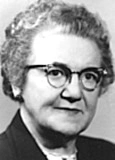
I Have the Goods on You: The Disappearance of Maud Crawford
Maud Robinson Crawford was 65 years old, one of the earliest female attorneys in the state of Arkansas, when she vanished from her home in Camden on the night of March 2, 1957. She had built an entire career out of persistence in a field that offered her little natural welcome, teaching herself the law rather than attending law school and then passing the bar exam with the highest score in her class. Her disappearance would go unresolved through official channels for the rest of the twentieth century, only to be pried back open decades later by a journalist who returned to her hometown and refused to let the story stay buried, even as the people she interviewed grew visibly afraid to talk to her.
From Stenographer to Trailblazer
Maud was born in Greenville, Texas, on June 22, 1891, and after her mother's death when Maud was only nine years old, she was raised by her grandmother in Warren, Arkansas. She graduated as valedictorian of her high school class in 1911 and briefly attended the University of Arkansas before beginning her working life in 1916 as a stenographer at the Gaughan law firm in Camden. It was from that starting position that she eventually built an extraordinary career. In 1927, rather than attending law school, Maud read for the law, a traditional path of self-directed legal study, and went on to pass the bar exam ahead of everyone else in her class. She became one of the earliest women in Arkansas to practice law, specializing in abstract and title work during the state's oil boom years, eventually becoming a partner at the very firm where U.S. Senator John L. McClellan had once practiced.
A Life of Civic Leadership
Maud's ambitions were never confined to the courtroom alone. She served on the Camden City Council from 1940 to 1948, becoming the first woman ever elected to that body. In 1942, she co-founded Arkansas Girls State, a program designed to introduce high school girls to the workings of state government, and she continued mentoring participants in that program every year right up until her disappearance. She led multiple women's civic organizations over the years and was named Woman of the Year by the Pilot Club in 1954, a life defined by an unusual and consistent commitment to public service alongside her legal practice.
An Ordinary Evening That Ended in Silence
On the night of March 2, 1957, Maud's husband, Clyde Falwell Crawford, left their home on northwest Clifton Street around 8:30 p.m. to visit a movie theater and stop at a liquor store. Around that same time, a cousin called the house and spoke briefly with Maud, a conversation that would turn out to be the last confirmed contact anyone had with her. When Clyde returned home around 11:00 or 11:30 that night, he found the house fully lit, the television still running, and a pan of beans sitting out on the table, exactly the kind of scene one would expect to walk into if a spouse had simply stepped away for a moment. Maud herself was nowhere to be found. Her purse, containing more than 100 dollars, remained behind. Her car sat in the driveway with the keys still in the ignition. The family's guard dog showed no signs of having reacted to any disturbance. Nothing about the scene suggested Maud had left willingly, and everything about it suggested she had been taken from a home she had no intention of leaving that night.
An Early Theory That Went Nowhere
In the immediate aftermath of her disappearance, one working theory held that organized crime figures had kidnapped Maud in an effort to intimidate her former law partner, Senator John McClellan, who was at the time conducting high profile investigations into corruption within organized labor. That theory lost momentum quickly, however, once no ransom demand or any other form of contact ever materialized, leaving investigators without a clear direction to pursue and Maud's case to drift, unresolved, for decades.
The Fortune Behind Rose Berg's Will
The theory that would eventually come to dominate serious discussion of Maud's case centered not on organized crime or federal politics, but on a wealthy, elderly client. Maud served as both attorney and court appointed guardian for Rose Berg, an elderly woman whose estate, built on oil and timber holdings, was valued at more than 20 million dollars. When the Ouachita County Court declared Rose legally incompetent in 1955, Maud was appointed as her guardian and as executor of her will, a will that directed Rose's substantial fortune to three nieces living out of state rather than to Rose's nephew, Henry Myar "Mike" Berg. In the course of managing Rose's affairs, Maud reportedly discovered a series of fraudulent deeds filed at the Hempstead County Courthouse, documents that appeared to show valuable timber assets and oil royalties being quietly transferred out of Rose's estate and into Berg's control through intermediaries.
"I Have the Goods on You"
According to Odis A. Henley, the original Arkansas State Police detective assigned to investigate the fraud allegations, Maud confronted Mike Berg directly about what she had uncovered, somewhere between one and two months before she disappeared, telling him plainly that she had the goods on him. Henley later said that his own superiors pulled him off the investigation shortly afterward, telling him there was too much money involved to keep pursuing it, and that his case files connected to the fraud subsequently vanished entirely. After Maud disappeared, the will she had drawn up for Rose Berg disappeared along with her, and Mike Berg ultimately gained control of the entire Berg estate, eventually settling with Rose's three nieces for 187,000 dollars each, a fraction of what the full inheritance would have been worth.
A Journalist Returns Home
The case remained largely dormant for nearly three decades until 1986, when journalist Beth Brickell, a Camden native, returned to her hometown and began digging into what had actually happened to Maud Crawford. Brickell set aside essentially every other commitment in her life for sixteen months to pursue the story, ultimately producing an eighteen part investigative series that ran on the front page of the Pulitzer Prize winning Arkansas Gazette over roughly five months. The newspaper faced a legal threat aimed at halting publication partway through the series, reportedly from Berg's widow, but the Gazette declined to back down and published the series in full. Brickell later described discovering that many of the people she interviewed remained visibly frightened even more than thirty years after Maud vanished, and that she herself received threats during the course of her research.
A Bodyguard Who Died Hours Later
The renewed attention generated by Brickell's reporting led prosecutor Bill McLean to reopen the case, and investigators attempted to interview Jack Dorris, a man who had worked as Mike Berg's bodyguard. When investigators arrived to speak with him, they found Dorris surrounded by family members and local law enforcement. Dorris died of cancer only seven hours later, taking with him whatever knowledge he may have held about the events surrounding Maud's disappearance.
Declared Dead, Never Resolved
In 1969, twelve years after she vanished, the Ouachita County Probate Court formally declared Maud Crawford deceased as a result of foul play perpetrated by a person or persons unknown, a legal acknowledgment that something violent had happened to her without ever identifying who was responsible. Mike Berg died in 1975 without ever facing charges connected to Maud's disappearance, and by the time Brickell's original reporting reopened public interest in the case, virtually every other participant, witness, and original investigator connected to the story had died as well.
A Case Still Missing Its Center
Beth Brickell continued researching and writing about Maud Crawford's disappearance for decades after her original newspaper series, eventually publishing multiple books on the subject, including a 2022 volume she described as finally solving the mystery of what had happened. Despite that ongoing work, no criminal charges have ever been filed against anyone in connection with Maud's disappearance, and her remains have never been found. Nearly seventy years after she vanished from a fully lit house with a pan of beans still sitting on the table, the woman who broke barriers to become one of Arkansas's first female attorneys, and who was apparently willing to confront a powerful man about the fraud she had uncovered, remains one of the state's most enduring unsolved mysteries, a case where almost everyone believes they know who was responsible, and where no one was ever made to answer for it.
Sources
- The Charley Project: Maud Robinson Crawford
- Encyclopedia of Arkansas: Maud Robinson Crawford (1891–1957)
- Fox16/KLRT: Small town's biggest secret, Author says Arkansas woman's 1957 disappearance is full of corruption
- AY Magazine: Murder Mystery, The Disappearance of Maud Crawford
- UALR Public Radio: Encyclopedia Of Arkansas Minute, Maud Crawford
- Arkansas Women's Hall of Fame: Maud R. Crawford (1891-1957)
- Southern Mysteries Podcast: Vanished in Camden, The Disappearance of Maud Crawford
- The Mystery Delver: The Mystery of Miss Maud