I Wanted to Be the One Who Saved Her: The Disappearance of Amber Jean Swartz-Garcia
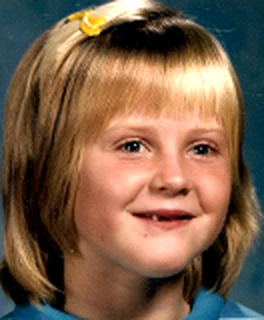
Amber Jean Swartz-Garcia was seven years old on June 3, 1988, living with her mother, Kim, in Pinole, California, a small city on the northeastern shore of San Francisco Bay. She was a blonde haired, blue eyed girl, about four feet tall and sixty five pounds, with crooked teeth and a missing upper right front tooth, pierced ears, a scar above her right eyebrow, and moles on her throat and lower lip. Amber had a significant hearing impairment that required a hearing aid and relied partly on lip reading to communicate, and she also suffered from migraine headaches stemming from a concussion she had sustained in 1984, managed with a prescription medication called Fiornal. Her father, Floyd "Bernie" Swartz, had been a police officer who was shot and killed in the line of duty in May 1980, three months before Amber was even born, a loss that shaped the family long before Amber herself ever appeared in it.
On the afternoon of June 3, Kim allowed Amber to play outside alone in the family's front yard on Savage Avenue, an arrangement that was unusual for the household but made sense that day because neighbors were expected to stop by. At around 4:15 in the afternoon, Amber was jumping rope with an adult sized leather jump rope that had wooden handles. Fifteen minutes later, when her mother checked on her, Amber was gone. She had left behind neither her hearing aid nor her migraine medication, and the jump rope she had been using disappeared along with her.
An Early, Troubling Sighting
A witness later told investigators they had seen a girl matching Amber's description at Alvarado Park sometime between 4:45 and 5:00 that evening, being forced into a vehicle by a white man in his forties, around five foot seven and a hundred sixty pounds. Extensive searches involving cadaver dogs, volunteers combing the surrounding neighborhoods, and helicopters scanning from above turned up nothing conclusive. The following day, June 4, a pair of pink socks matching the clothing Amber had been wearing were found near her home, though investigators were never able to confirm with certainty that they had belonged to her.
In the weeks that followed, two possible sightings emerged from outside the immediate area. On August 2, 1988, a couple in Sacramento reported contact with a child matching Amber's description in the Sierra foothills. Ten days later, on August 12, a woman in the small community of Camp Connell, roughly a hundred miles north of Pinole, reported that a girl had approached her identifying herself as Amber, before disappearing again with an unknown couple. Investigators were unable to follow up meaningfully on that lead because the woman's contact information was not obtained at the time, a gap that, whatever the sighting actually amounted to, closed off any chance of confirming or ruling it out later.
A Man Who Kept Showing Up
Three days after Amber vanished, a man named Timothy Bindner appeared at the Swartz family's home, offering to help with the search and later explaining, in his own words, that he "wanted to be the one who saved her." On its own, that kind of offer from a stranger might have meant nothing. It became considerably more troubling once investigators noticed that Bindner had a habit of showing up, uninvited, at the homes of other Bay Area families whose children went missing in the years that followed Amber's disappearance, including Michaela Joy Garecht, abducted in November 1988, Ilene Beth Misheloff, who vanished in January 1989, an attempted abduction of a girl named Alecia Christopherson in February 1989, and the December 1991 disappearance of four year old Amanda Nicole Eileen Campbell.
Bindner's behavior around those later cases raised even more questions. In a letter he wrote at one point, he speculated that the next child taken would be nine years old, a detail that lined up unsettlingly well with Michaela Garecht's actual age when she was abducted soon after. He also sent an FBI profiler a Christmas card that featured an image of a child holding up four fingers, not long before four year old Amanda Campbell was taken. During an interview conducted at four thirty in the morning in a cemetery with a reporter from the Mercury News, Bindner was asked directly what had happened to the missing girls, and answered that "one of them was sweet and shy, the other went kicking and screaming," before later insisting he had only been speculating aloud rather than describing anything he actually knew.
Investigators also learned that Bindner visited the grave of Angela Bugay, a young girl murdered in an earlier, unrelated case, as often as ninety times a year. Bloodhounds brought in during the investigation reportedly detected Amber's scent at that same gravesite, and separately picked up Amanda Campbell's scent there as well. Despite how suggestive that evidence seemed on its face, bloodhound scent evidence of that kind is not admissible in court, and no charges against Bindner ever followed from any of it. Bindner, for his part, later won a ninety thousand dollar defamation lawsuit against Amanda Campbell's hometown over how he had been treated in connection with her case, a legal outcome that left his actual role in any of these disappearances as unresolved as it had always been.
Another Suspect Close to Home
Bindner was not the only person investigators looked at closely. A defrocked Catholic priest named Stephen Kiesle lived just fourteen houses away from Amber's own home on Savage Avenue. Kiesle had been convicted of molesting multiple children at parishes across the area between 1968 and 1985, a record that made him an obvious person of interest once his proximity to the Swartz household became known. He was named as a suspect in Amber's case during the 1990s but was never formally charged in connection with her disappearance specifically, leaving his exact relationship to what happened to her, like so much else in this case, undetermined.
A Confession Nobody Could Confirm
The case remained unsolved and largely unchanged for close to two decades, until November 2007, when a convicted serial killer named Curtis Dean Anderson told federal agents that he had been the one who abducted Amber. Anderson was already known to have murdered seven year old Xiana Fairchild of nearby Vallejo and to have sexually assaulted a girl named Midsi Sanchez, who survived her attack and was able to identify him. He had reportedly bragged, at various points, about having kidnapped as many as eleven girls over the course of his crimes. According to what Anderson told investigators, he had been driving through Pinole on his way toward Arizona when he abducted Amber, sedated her with schnapps, and ultimately killed her by suffocation in a motel near Tucson before disposing of her body along Highway 10 near Benson, Arizona.
An FBI profiler who reviewed Anderson's account reportedly found it credible. But Anderson died in prison in December 2007, before investigators were able to administer a polygraph test to him, and an eighteen month follow up investigation found no physical evidence either supporting or contradicting what he had claimed. No remains connected to Amber were ever recovered in Arizona or anywhere else. Kim Swartz-Garcia, Amber's mother, never accepted Anderson's confession as the truth, believing instead that he had fabricated the story, whether for attention, notoriety, or some other motive of his own, during the final stretch of a life he knew was ending regardless.
Despite the lack of confirming evidence, authorities at one point moved to close the case based on Anderson's account. Kim petitioned against that closure, and following a public campaign in 2013, Pinole police agreed to formally reopen the investigation into her daughter's disappearance, a status the case has held ever since, still technically active, still without a resolution either family or investigators can point to with confidence.
A Mother's Long Search
In the years following Amber's disappearance, Kim Swartz-Garcia founded the Amber Foundation for Missing Children, turning her own unanswered loss into an organization aimed at supporting other families going through the same uncertainty she had lived with since 1988. That kind of transformation, private grief becoming public advocacy, has become a familiar pattern among parents of long term missing children, though it does not change the fundamental fact at the center of Amber's case: no one has ever been convicted of taking her, no body has ever been found, and the confession that came closest to answering the question of what happened to her came from a dying man whose credibility even the investigators who found him believable could never fully verify.
Amber Jean Swartz-Garcia would be in her mid forties today had she lived. She has now been missing for more than thirty seven years, one of a cluster of Bay Area child disappearances from the late 1980s that investigators have long suspected, without ever quite being able to prove, might all trace back to the same person or people. Whether that person was Timothy Bindner, watching from the edges of one grieving family's life after another, or Curtis Dean Anderson, confessing from a prison cell with nothing left to lose, or someone whose name has never surfaced in the case at all, remains, decades later, exactly what it was on the afternoon her mother found an empty front yard and a missing jump rope. Unknown.
Sources
- The Charley Project: Amber Jean Swartz-Garcia
- Wikipedia: Kidnapping of Amber Swartz-Garcia
- The Resource Center for Cold Case Missing Children's Cases: Amber Jean Swartz-Garcia
- NBC Bay Area: Pinole Police Announce Killer of Amber Swartz-Garcia
- Fox News: Police in Calif. Re-open Amber Swartz Case
- California Department of Justice: Amber Jean Swartz-Garcia