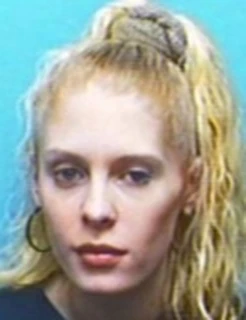
A Photograph That Read Die Soon: The Disappearance of Kimberly Ann Riley
Kimberly Ann Riley was nineteen years old in December 1998, living in Lorain, Ohio, a small city on Lake Erie west of Cleveland. She was a white woman, five foot two, weighing a hundred twenty two pounds, with blonde hair and blue eyes, a scar on her forehead, an appendectomy scar on her abdomen, and a mole on her neck. As a child, Kimberly had lost the nail on her left ring finger in an accident, and by adulthood she had grown self conscious enough about it that she typically wore a prosthetic nail to cover the spot. She was the mother of two young sons, both fathered by her boyfriend, Omar Scharief Seymore Sr. Her grandmother last saw her looking entirely normal on December 20, just three days before she disappeared.
On December 23, 1998, according to an account later given by Seymore's mother, Linda Waters, Kimberly dropped her two sons off at Waters's apartment, telling her she was heading out to do some last minute Christmas shopping at a mall in nearby Elyria. She never came back for them. She did not show up two days later for her family's Christmas celebration on December 25, a holiday absence that, for a young mother who had just casually mentioned holiday shopping days earlier, immediately struck her family as deeply wrong.
An Apartment Left Mid Motion
When investigators and family members went through Kimberly's apartment in the days that followed, what they found painted a picture of someone who had every intention of returning shortly. Wrapped Christmas gifts remained sitting untouched inside. Her medication for a blood platelet disorder, something she depended on regularly, was still there, along with groceries, toiletries, and hair curlers, the ordinary debris of someone in the middle of an unremarkable week rather than someone preparing to leave. And yet certain things were missing in a way that complicated that picture considerably. Some blankets were gone from her bed. Two photo albums containing pictures of her children had disappeared. A large plastic trash bin from her kitchen was also gone, an oddly specific and mundane item to notice missing, and one that has struck investigators over the years as a potentially troubling detail rather than an incidental one.
Kimberly's orange 1989 Mazda was eventually located, stripped down, abandoned in Cleveland. When investigators examined the vehicle, they found bloodstains on the passenger side of the car's interior, along with hair and bloodstained pieces of cardboard inside the trunk. Testing conducted on that evidence, though it reportedly took years to complete, ultimately confirmed that the blood belonged to Kimberly herself.
A Boyfriend Who Vanished Alongside Her
Omar Seymore, the father of Kimberly's two sons, was reported missing around the same general period that Kimberly disappeared, a detail that for a time left investigators considering the possibility that the couple might have left together, whether voluntarily or otherwise. That theory did not hold up. In 2004, roughly six years after Kimberly vanished, Seymore was located, having resurfaced on unrelated drug charges. Kimberly was not with him, and he offered no explanation for where she might be or what had happened to her during the years he had been gone. Seymore was later incarcerated separately on parole violations connected to that same period.
When investigators eventually had the opportunity to question Seymore directly about Kimberly's disappearance, he refused to provide any information about her whereabouts, invoking his right against self incrimination rather than answering questions about a woman who was, by that point, the mother of his own two children and had been missing for years. That refusal, paired with the bloodstained evidence recovered from Kimberly's own car, made Seymore the central and enduring focus of suspicion in the case, even though it never resulted in criminal charges being filed against him.
Die Soon
Perhaps the single most unsettling piece of evidence connected to Kimberly's case surfaced sometime after her disappearance, when her mother came across a photograph of Kimberly inside a residence where Kimberly had once lived with Seymore. Written across that photograph, in a detail that has stayed with nearly everyone who has ever researched this case, were the words die soon. No one has ever publicly established with certainty who wrote those words or exactly when, but their discovery, in a home connected directly to the man investigators already suspected, has remained one of the case's most disturbing and difficult to explain details.
Kimberly Ann Riley was formally declared legally dead on March 10, 2006, roughly seven and a half years after she vanished. That declaration cleared the way for a civil wrongful death lawsuit that Kimberly's mother subsequently pursued against Seymore. In 2007, a civil court found Seymore liable for Kimberly's wrongful death and ordered him to pay four and a half million dollars in damages to her mother, a judgment that arrived, at least in part, because Seymore chose not to mount any real defense against the claims brought against him. That verdict, significant as it was in a civil courtroom, has never been matched by any criminal charge. No one has ever been arrested or prosecuted for Kimberly's disappearance or presumed murder, and Seymore has continued to maintain, at least publicly, that no criminal case was ever filed against him in connection with what happened to her.
The gap between what a wrongful death judgment can accomplish and what a murder conviction requires is a distinction that matters enormously to a family in Kimberly's position. A civil court operates on a preponderance of the evidence, a standard that only asks whether it is more likely than not that a defendant caused a death, and Seymore's decision not to contest the lawsuit made that already lower bar even easier to clear. A criminal prosecution demands proof beyond a reasonable doubt, and prosecutors in Lorain County have apparently never felt they had enough to meet that far higher standard against Seymore specifically, despite the blood evidence, the missing items from Kimberly's apartment, his own refusal to answer questions, and the photograph bearing those two chilling words. The result is a case where the person closest to Kimberly at the time of her disappearance has been held financially responsible for her death in one courtroom while never facing so much as an indictment in another.
A Case That Remains Open
More than a quarter century has now passed since Kimberly Riley dropped her sons off with their grandmother and drove away, never to return. Her body has never been found. The trash bin missing from her kitchen, the blankets pulled from her bed, the photo albums that vanished along with her, and the blood recovered from her own car have all remained pieces of a story that investigators believe they understand in its broad outline without ever having been able to prove it to the standard a criminal court requires. Kimberly would be in her mid forties today, quite possibly a grandmother herself by now, had the ordinary trajectory of her life continued rather than ending, as the physical evidence so strongly suggests it did, sometime around the very day she said she was only going to the mall.
Her case remains formally unsolved and open with Ohio authorities. Anyone with information related to Kimberly Ann Riley's disappearance is encouraged to contact local law enforcement or submit a tip through the Doe Network or the Charley Project's case listing.
Sources
- The Charley Project: Kimberly Ann Riley
- The Charley Project Blog: MP of the Week, Kimberly Riley
- Doe Network: Kimberly Ann Riley
- Websleuths: OH, Kimberly Ann Riley (19), Lorain OH, 1998
- Crime Solvers Central: Kimberly Riley, Missing from Lorain, Ohio