Gone With the White Boat: The Indiana Dunes Disappearance of Patricia Blough, Ann Miller, and Renee Bruhl
On a hot Saturday in the summer of 1966, three young women from the Chicago suburbs drove out to a state park on the Indiana shore of Lake Michigan for what should have been an unremarkable day at the beach. They laid their towels on the sand, waded into the water, and at some point around noon struck up a conversation with a stranger piloting a small white boat just offshore. Witnesses watched all three women climb aboard and watched the boat speed away to the west. None of the three women, Patricia Blough, Ann Miller, and Renee Bruhl, was ever seen again. Their car sat untouched in the parking lot. Their towels, their wallets, their clothing, all of it stayed exactly where they had left it on the sand. Nearly six decades later, the case remains one of the most enduring unsolved mysteries in the Midwest, a disappearance that has produced theories involving illegal abortion rings, organized crime in the Chicago horse racing world, and a chilling, unconfirmed claim that someone once told a sheriff exactly where the bodies were buried.
Three Women, One Shared World
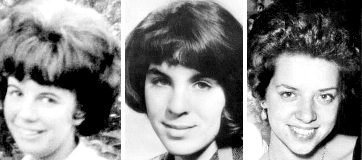
Patricia "Pat" Blough was 19 years old, an outgoing young woman who worked as a secretary at Commonwealth Edison. She was also a remarkably strong swimmer, reportedly capable of covering twenty to thirty miles in open water, a detail that would later complicate the simplest explanation for what happened to her. Ann Miller, at 21, was the oldest of the three. She worked as a horse exerciser at the Oak Brook Polo Club and was studying to become a legal secretary, with hopes of one day starting her own stable. Renee Bruhl, 19, had been married for about fifteen months and had recently completed a medical technology course in Chicago. All three young women shared a passion for horses, and it was through that shared world of stables, riding, and the competitive Chicago-area horse circuit that they had come to know each other. Patricia boarded her horse at the same stable where she met Ann, and both women, along with Renee, rode out of Tri Color Stables in Palatine, Illinois.
That equestrian connection would turn out to matter a great deal, because the Chicago horse market of the 1960s was not simply a hobbyist community. It was also, in certain corners, deeply entangled with organized crime, insurance fraud, and the kind of long-running personal feuds that occasionally turned lethal. Patricia herself had reportedly suffered a facial injury in March 1966, months before her disappearance, and had made cryptic remarks afterward referencing "horse syndicate people," comments that friends and family did not fully understand at the time but that investigators would later treat as significant. She had a prize-winning thoroughbred named Hank, who had won a race in Winnipeg just two weeks before she vanished, leaving behind roughly $900 in prize money that was never claimed.
The Day at the Dunes
On the morning of July 2, 1966, the three women climbed into Ann Miller's 1955 Buick and drove to Indiana Dunes State Park, arriving around 10 a.m. Ann had a horse show scheduled in Michigan, and the beach trip appears to have been a way to relax beforehand. They parked, hiked out toward the shoreline, and settled in on the sand roughly a hundred yards from the water.
Around noon, other beachgoers watched the three women leave their towels, their clothing, and their personal effects on the sand and wade into Lake Michigan together. At some point while they were in the water, witnesses saw them approach and speak with a man operating a small boat, fourteen to sixteen feet long, white, with a blue interior and an outboard motor. He was described as being in his early twenties, well-built, with dark, wavy hair. Whatever was said between them, it ended with all three women climbing aboard his boat. The vessel then turned and headed west, out into the lake, and disappeared from the view of anyone still watching from shore.
That was the last confirmed sighting of Patricia Blough, Ann Miller, and Renee Bruhl. When they failed to return and failed to make it to Ann's scheduled horse show, family members grew alarmed, and a formal search began on July 5. Investigators found the Buick still sitting in the park's lot, undisturbed. On the beach, Patricia's yellow robe and five dollars remained where she'd left them. Renee's belongings included a towel, some clothing, and roughly fifty five dollars in checks. Nothing suggested a struggle. Nothing suggested anyone had come back for their things. The scene looked less like the aftermath of a crime than like three women who had simply walked into the lake and never walked back out, except for the inconvenient detail of the boat and the man who had taken them somewhere no one could find.
A Search That Found Nothing
The search effort that followed was substantial for its time, drawing in local law enforcement, the United States Coast Guard, and eventually the FBI. Investigators combed the shoreline and the surrounding waters for any trace of the women or the boat that had carried them away. They came up empty. No bodies washed ashore, an absence that struck some investigators as unusual on its own, since Lake Michigan drownings, even accidental ones involving strong currents and dangerous rip tides near the dunes, typically produce remains that eventually surface somewhere along the coast. Nothing ever did.
One useful lead did emerge from an unlikely source: home movie footage shot by a beachgoer that day happened to capture boats out on the water, and investigators were able to use it to narrow their focus to two specific vessels, including a larger Trojan cabin cruiser that reportedly had three men and three women aboard it at some point that afternoon. Neither boat, nor the people connected to them, was ever definitively identified or located. The unidentified boatman with the dark wavy hair, whoever he was, vanished from the historical record as completely as the three women he had apparently taken away.
The Abortion Theory
Within the community and eventually within the investigation itself, one theory gained particular traction: that the women had gone out to that boat not by chance encounter but by prior arrangement, seeking illegal abortions at a time when the procedure was against the law everywhere in the country. Rumors, some emerging years after the disappearance, suggested that both Ann Miller and Patricia Blough may have been pregnant at the time, with Ann reportedly around three months along, though neither claim was ever confirmed. Investigators focused attention on a man named Ralph Largo Jr., a local figure who reportedly resembled the description of the boat's operator and whose aunt and uncle were believed to perform illegal abortions in the Gary, Indiana area. Under this theory, the three women arranged to meet Largo's boat, were taken to a location for a procedure, and died there, whether from complications, from being deliberately silenced, or from some combination of the two, with their remains disposed of in Lake Michigan rather than left to be discovered. Nothing about this theory was ever proven, and Largo himself was never charged with any crime connected to the case. It has remained, for decades, an explanation that fits some of the known facts without ever being confirmed by any of them.
The Jayne Family and a Sheriff's Chilling Claim
A second, darker theory ties the women's disappearance to organized crime within the same Chicago-area horse world that connected all three of them. In 1965, the year before the women vanished, a car bombing had struck Tri Color Stables, the very stable where Renee, Patricia, and Ann rode, an attack connected to a bitter and long-running feud involving horse dealer George Jayne and his brother Silas Jayne, figures well known in Chicago's horse racing and breeding circles for both legitimate business and considerably less legitimate dealings, including insurance fraud schemes involving horses and, eventually, murder. Investigators later discovered that phone numbers belonging to George and Silas Jayne turned up among the belongings of one of the missing women, a detail that raised the unsettling possibility that the three friends may have known something, or seen something, connected to the stable bombing or the broader Jayne family conflict, and that their disappearance was less an accident than a deliberate act of witness intimidation or elimination.
The most chilling piece of this theory comes from an account that Silas Jayne, at some point, told a local sheriff that he had three bodies buried underneath his own residence. According to that account, the officer who received this claim died in a farming accident before any search of the property could be carried out, and the lead, whatever it might have amounted to, was never followed up on by anyone else. Silas Jayne would go on, years later, to be convicted in connection with the 1970 murder of his own brother George, a killing that confirmed just how far the Jayne family conflict was capable of going and lent grim credibility to the idea that the same world could have swallowed three young women four years earlier and left nothing behind to prove it.
Nearly Sixty Years Without Answers
None of these theories, the abortion arranged with Ralph Largo, the Jayne family connection, or the simplest and least examined possibility of straightforward abduction by a predatory stranger, has ever been proven or ruled out with any finality. The case of Patricia Blough, Ann Miller, and Renee Bruhl remains classified as open but inactive, a designation that reflects both the total absence of new evidence in the decades since 1966 and the fact that no one has ever formally closed the door on solving it. Indiana Dunes State Park itself is now part of Indiana Dunes National Lakeshore, a stretch of protected shoreline visited by millions of people a year, most of whom have no idea that sixty years ago three young women waded into that same water and never came out.
What makes this case endure in local memory, more than most disappearances of its era, is the sheer specificity of its final image: three friends, connected by horses and stables and the ordinary business of being young women in 1966, wading into a lake together, talking briefly to a stranger on a boat, and climbing aboard it in full view of other people on the beach, only to be carried out of sight and out of history entirely. Their families spent the rest of their lives without bodies to bury, without a boat ever identified, and without a single person ever charged in connection with whatever happened to Patricia, Ann, and Renee once that white boat with the blue interior turned west and disappeared into Lake Michigan.
Sources
- The Charley Project: Patricia Blough
- The Charley Project: Ann Miller
- The Charley Project: Renee Bruhl
- DoeNetwork: 662DFIN - Patricia Blough
- NWI Times: Bruhl, Blough, Miller: Dunes disappearance remains unsolved years later
- City Towner: The Mysterious Disappearance of Patricia Blough, Renee Bruhl, and Ann Miller at Indiana Dunes State Park
- Factual America: The Indiana Dunes Mystery: What Happened to the Three Women Who Vanished in 1966?
- Trackmissing.org: Patricia Blough Case File