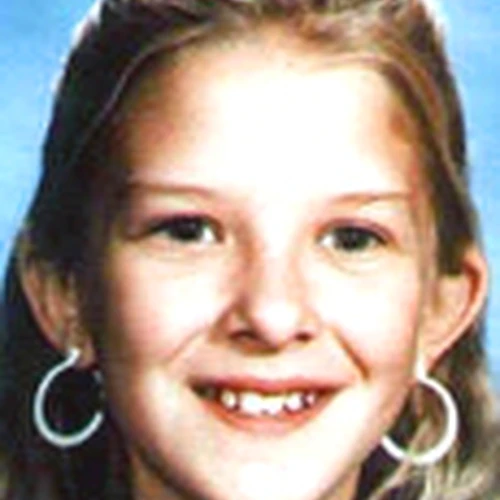
Blood on the Walls, Glasses in the Mail: Leigh Occhi
Leigh Marine Occhi was thirteen years old, living with her mother, Vickie Felton, at their home on Honey Locust Drive in Tupelo, Mississippi. On the morning of August 27, 1992, Vickie left for work around eight o'clock, leaving Leigh home alone, the first time her mother had allowed her that kind of independence. Leigh planned to attend an open house at her middle school later with her grandmother. Before nine that morning, with Hurricane Andrew approaching the region, Vickie called home to warn her daughter about the storm. Leigh did not answer. Concerned, Vickie drove back to the house herself, and when she arrived she found the garage door standing open with the lights still on inside.
What she discovered once she went in changed the rest of her life permanently. Blood was smeared across a wall, and as Vickie later described it, she began calling out for Leigh and moving through every room in the house, finding more blood as she went, pooled in the upstairs bedroom, smeared through the hallway, in the bathroom, and on the bedroom door itself. There was evidence someone had attempted to clean part of the bathroom afterward. A nightgown stained with blood turned up in the laundry hamper. Leigh's reading glasses, her shoes, some of her clothing, and a sleeping bag were all missing from the house. There was no sign that anyone had forced their way in from outside.
An Injury Above the Neck
Investigators who processed the scene worked from the blood evidence to draw some tentative conclusions about what might have happened to Leigh inside her own home. Tupelo Police Chief Bart Aguirre said at the time that based on the blood patterns recovered, whatever injury Leigh sustained had to have been above the neck, possibly consistent with a blow to the head. A trail of blood suggested she may have struck her head against a door frame at some point during whatever happened that morning. Beyond that, the physical evidence left investigators with more questions than answers, a house full of signs that something violent had taken place, but no body, no weapon, and no witness to any part of it.
A Package With No Note
The case took an unexpected turn on September 9, 1992, roughly two weeks after Leigh disappeared, when a small package arrived in the mail addressed to Barney Yarborough, Leigh's stepfather, who had separated from Vickie Felton only about two weeks before Leigh vanished. Inside was Leigh's own pair of eyeglasses. The package was postmarked from Booneville, Mississippi, a town roughly thirty miles north of Tupelo. There was no ransom note, no demand, no explanation of any kind included alongside the glasses. Chief Aguirre later said he believed the package was intended as a distraction rather than a genuine communication, precisely because it arrived without any of the elements, a demand, a threat, a proof of life, that would typically accompany contact from someone actually holding a kidnapped child for ransom. The FBI attempted DNA testing on the envelope's stamps, hoping saliva used to seal it might yield genetic material, but found the stamps had been moistened with plain water instead, leaving investigators with no biological evidence from the one piece of physical contact anyone connected to Leigh's disappearance had made with the outside world since she vanished.
Around the same period, a McDonald's employee in Booneville reported seeing a girl resembling Leigh come through the restaurant's drive-through, a lead investigators pursued and ultimately determined involved a different girl entirely, unrelated to the case.
A Family Under Its Own Scrutiny
Barney Yarborough, the stepfather to whom Leigh's glasses had been mailed, became an early focus of the investigation given both his recent separation from Vickie and rumors that circulated suggesting he had been abusive toward Leigh at some point. Yarborough provided investigators with a substantiated alibi for the morning Leigh disappeared and passed a polygraph examination, and law enforcement ultimately ruled him out as a suspect.
Vickie Felton herself faced considerably more sustained scrutiny over the years that followed, an experience that placed genuine strain on a mother already living through the worst possible circumstance. She submitted to three separate polygraph examinations, one administered locally and two by the FBI, and independent examiners reportedly determined she showed signs of deception across all three tests. As recently as 2017, Chief Aguirre told reporters that investigators still could not fully eliminate Vickie from consideration, citing what he described as too many unanswered questions surrounding the case, even as Vickie has consistently and firmly disputed any involvement in her daughter's disappearance and has instead pointed toward a different suspect entirely.
Leigh's father, Donald Occhi, who had divorced Vickie years earlier and was stationed with the Army overseas at the time Leigh vanished, has said he became convinced his daughter was already dead the moment his ex-wife first called him with the news. He has stated bluntly that he believes some person beat his daughter to death inside that house. During his own efforts to search for Leigh in the weeks following her disappearance, Donald said local residents in the area told him directly to look at her mother, a suggestion he has said only reinforced suspicions he was already independently pursuing.
A Sunday School Teacher's Later Crimes
The suspect Vickie Felton has consistently pointed to as most likely responsible for what happened to her daughter is Oscar McKinley Kearns, known as Mike, a man who had known Leigh through connections at a local church and who taught Sunday school in the Tupelo area. Nine months after Leigh disappeared, Kearns kidnapped a fifteen year old girl he had also met through the same church, driving her to Memphis, Tennessee, where he sexually assaulted her. He was eventually convicted in connection with that crime and a related later offense involving the kidnapping of a couple and the rape of the woman, receiving a sentence of just over eight years, of which he ultimately served only about half before his release in 1997. Kearns consistently refused to be interviewed or to submit to a polygraph examination specifically regarding Leigh's disappearance, a refusal that, combined with his documented history of similar crimes against teenage girls he met through church connections in the same community around the same period, has kept him at the center of the case for Vickie Felton and many who have followed the investigation closely in the decades since. Kearns died in 2021, having never been charged in connection with Leigh's disappearance and never having answered investigators' questions about it directly.
A False Identification
In November 1993, more than a year after Leigh vanished, a skull discovered in a soybean field was initially matched to her through dental records, a development that appeared, briefly, to finally offer the family the terrible certainty of confirmed remains after more than a year of not knowing. That identification was retracted within days, once further forensic testing revealed the skull actually belonged to a different missing woman, twenty seven year old Pollyanna Sue Keith, who had disappeared from a neighboring town in March 1993. The retraction left the Occhi and Felton families back where they had started, still without any physical trace of Leigh at all.
A Renewed Search, Then a Legal Declaration
The case has never gone fully cold in the sense of losing all active attention. In January 2025, the Mississippi Bureau of Investigation's Cold Case Unit, working alongside Tupelo Police and the FBI, conducted a renewed search near Leigh's former childhood home, more than three decades after she disappeared. Investigators involved in that search stated at the time that specific findings could not be disclosed publicly, leaving the exact purpose and outcome of that particular search largely unknown to the public even as it confirmed the case remained an active priority for multiple agencies well into its fourth decade.
That renewed activity coincided with a significant legal step taken by Leigh's own parents. On October 1, 2024, Vickie Felton filed a petition in Lee County Chancery Court asking that Leigh formally be declared legally dead, a request Donald Occhi joined the following day. Mississippi law allows a person to be presumed dead after seven consecutive years without contact, a threshold Leigh's case had passed decades earlier, but her parents had apparently held off pursuing the formal declaration until that point. On October 16, 2024, Lee County Chancellor Stephen Bailey signed the order. Vickie explained her decision simply, saying she had just decided it was time, noting that it had, by then, been thirty two years.
Still an Open Investigation
Despite the legal declaration of death, Tupelo police have been clear that Leigh's case remains an open missing persons investigation rather than a closed matter, a status that reflects both the total absence of recovered remains and the department's stated position that questions surrounding her disappearance are still actively being pursued. The case has drawn sustained national attention over the years, covered on Nancy Grace's program, the Geraldo Rivera Show, and 20/20, and more recently examined in depth by a dedicated six episode podcast series and by several true crime podcasts and YouTube programs that have continued introducing new audiences to a case that, more than three decades on, still has no confirmed answer.
No Trace, More Than Thirty Years Later
Leigh Occhi has never been found. The blood in her childhood bedroom, the eyeglasses mailed without explanation to a recently estranged stepfather, the Sunday school teacher who went on to commit strikingly similar crimes against other teenage girls in the years that followed, and a mother who has spent three decades under her own share of suspicion even while insisting on her daughter's memory and pushing for answers, all remain exactly where they were left in 1992, a collection of disturbing, unresolved pieces that has never assembled into anything resembling a conclusion.
Sources
- The Charley Project: Leigh Marine Occhi
- Wikipedia: Disappearance of Leigh Occhi
- Daily Journal: Leigh Occhi, missing since 1992, declared legally dead
- SuperTalk Mississippi: Tupelo teen Leigh Occhi declared dead after going missing 32 years ago
- All That's Interesting: Leigh Occhi, The Girl Who Disappeared From Her Own Home In 1992