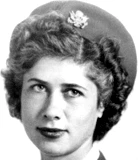
Into the Fog Over Santa Monica Bay: The Disappearance of Gertrude Tompkins Silver
Gertrude Vreeland Tompkins, known to those close to her as Tommy, was born in Jersey City, New Jersey, on October 16, 1912, the youngest of three daughters in a family that later settled in Summit, New Jersey. As a girl, Gertrude was shy and dealt with a severe stutter, and before the war she pursued a quieter kind of life, attending horticultural school, raising goats, and touring gardens across Italy and England. Her path changed after a man she loved, a pilot flying for the Royal Air Force, was killed in action. Inspired by his death rather than deterred by it, Gertrude decided to learn to fly herself and eventually to serve her country in the same skies that had taken him.
She went on to become one of 1,074 women who successfully completed the grueling training required to join the Women Airforce Service Pilots, known as the WASP, a program that allowed women to fly military aircraft within the United States during World War II, freeing up male pilots for combat duty overseas. Gertrude qualified to fly some of the most demanding aircraft in the American arsenal, including the P-51 Mustang, the P-38 Lightning, and the P-47 Thunderbolt. By the time she disappeared, she had logged more than eight hundred fifty hours of flight time in total, including forty six hours specifically in the P-51 and seventeen hours in the newer P-51D model she would be flying on her final mission. Those who knew her said flying had transformed her, helping her overcome her stutter and giving her a confidence that had not come easily earlier in her life. At thirty three, she was noticeably older than most of her fellow WASPs, many of whom were in their twenties. In September 1944, just weeks before she vanished, Gertrude secretly married Army Technical Sergeant Henry Mann Silver, keeping the marriage quiet in part because WASP policy generally preferred its pilots remain unmarried, and in part out of fear that using her married name professionally might cost her the flying career she had worked so hard to build.
A Fogbound Departure
On October 26, 1944, Gertrude arrived at North American Aviation's factory at Mines Field in Inglewood, California, now the site of Los Angeles International Airport, to pick up a brand new P-51D Mustang, aircraft number 669, that she was assigned to ferry to Coolidge Field in Arizona. She took off at approximately 3:42 in the afternoon, though a minor repair needed to the aircraft's door delayed her departure and left some witnesses recalling the actual takeoff closer to four o'clock. Conditions that afternoon were poor. Haze extended up to 2,300 feet at the moment she departed, and a fog bank had settled over Santa Monica Bay, creating conditions that would have required something close to instrument flying even for an experienced pilot navigating unfamiliar terrain in a plane she had only recently begun to master.
Gertrude never arrived in Arizona, and nobody at Mines Field or anywhere else seemed to notice right away. It was not until October 30, four full days later, that her home station, the 5th Ferrying Group based at Love Field in Dallas, realized something was wrong, having noticed she had not submitted the daily reports required of every WASP pilot in transit. By then, whatever had happened to Gertrude and her aircraft had already happened days earlier, the trail as cold as it could possibly be before the military even understood there was a trail to follow at all.
A Search Involving 156 Aircraft
Once Gertrude's absence was confirmed, the military mounted an extensive search effort, ultimately involving 156 aircraft and logging more than 1,067 combined flying hours across searches spanning Southern California and Arizona. The Coast Guard specifically searched Santa Monica Bay, the most likely area given the fog conditions reported that afternoon, while the Civil Air Patrol investigated a separate report of possible wreckage near Toro Peak, a lead that ultimately turned out to be nothing more than a rock formation. No trace of Gertrude or her aircraft was ever found by any part of that search. Her death was formally reported to her father on November 22, 1944, and she was officially classified as missing and presumed dead. The investigation into her disappearance also revealed significant procedural failures connected to Form 23, the aircraft clearance documentation meant to track flights like hers, failures that led directly to regulatory improvements at Mines Field going forward, a small institutional legacy left behind by the same gaps that had allowed her disappearance to go unnoticed for four days in the first place.
The Only WASP Never Found
Thirty eight women died in service as WASP pilots during the program's existence, flying military aircraft domestically so that male pilots could be freed up for combat roles overseas. Of those thirty eight, Gertrude Tompkins Silver remains the only one whose remains and aircraft have never been located, a distinction that has kept her case active in aviation history and missing persons circles alike for more than eighty years. Airplane archaeologist G. Patric Macha has theorized that Gertrude's P-51D most likely went down somewhere in Santa Monica Bay, possibly after she became disoriented in the unfamiliar aircraft or struggled with the plane's canopy while flying nearly blind through the fog.
Gertrude's grand-niece, Laura Whittall, has spearheaded multiple dedicated search expeditions over the decades since the 1990s, organizing major efforts in 1997, 2004, and again in 2010, the last of which was documented by the Discovery Channel and featured explorer Josh Gates as part of a televised search for Gertrude's missing plane. Divers and aviation archaeologists working with organizations including the Missing Aircraft Search Team have combed the waters off Los Angeles International Airport repeatedly, and while those searches have successfully located and brought closure to other unrelated cold case aircraft wrecks, including a missing Air Force T-33 jet trainer lost since 1955 and other World War II era wreckage scattered throughout the bay, Gertrude's own P-51D has never turned up among any of it.
A Legacy Beyond the Mystery
The WASP program itself received long overdue formal recognition decades after Gertrude's disappearance, with its surviving members eventually granted veteran status and, in 2010, awarded the Congressional Gold Medal for their service. Laura Whittall has continued to hold out hope that improving sonar and search technology might eventually locate her great-aunt's aircraft where decades of earlier searches could not, and has spoken about Gertrude's life as a story of quiet transformation, describing a woman she believes was naturally introverted and lacking in confidence who nonetheless overcame a great deal to become one of the most accomplished pilots of her generation.
More than eighty years after she disappeared into the fog over Santa Monica Bay, Gertrude Vreeland Tompkins Silver remains missing, the last unresolved case among the thirty eight women who gave their lives flying for their country during World War II, somewhere beneath the same waters that have already given up so many of the region's other lost aircraft, just never hers.
Sources
- The Charley Project: Gertrude Vreeland Tompkins Silver
- Army Times: A missing pilot, a Mustang and an enduring mystery, What happened to this WASP aviator?
- WWII Women Pilots: Gertrude V. Tompkins Silver, Missing In Service
- CAF Rise Above: Gertrude Tompkins Silver
- Wikipedia: Gertrude Tompkins Silver
- CNN: Fighter jet missing 5 decades found off California coast