The Babysitter Who Never Called Home: The Disappearance of Evelyn Hartley
On the night of October 24, 1953, while much of La Crosse, Wisconsin, was out celebrating the local homecoming game, a 15-year-old junior named Evelyn Hartley sat in a professor's living room a few blocks from campus, watching over a sleeping 20-month-old girl and working through her schoolbooks between checks on the crib. She had promised her father she would call home at 8:30 p.m. The call never came. When her father drove over to check on her, he found the house locked, the lights and radio still on, and the baby sleeping safely in her crib exactly where Evelyn had left her. Evelyn herself was gone, and in the more than seventy years since, she has never been found.
A Studious, Sheltered Girl
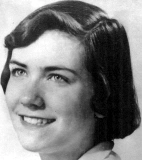
Evelyn Hartley was the daughter of a college professor, a junior at Central High School carrying a straight-A average and active enough in school life to be remembered by classmates and teachers alike. She played piano, sang in her church choir, and had, by every account, very little dating experience and no steady boyfriend at the time she disappeared. She was the youngest of four children in her family, one of whom, an older brother, had died of polio some years earlier, a loss that had already given the Hartley family more grief than most families accumulate by that point in their lives. Evelyn herself was, by nearly every description that survives her, exactly the kind of responsible, conscientious teenager a family would trust with an infant on a night when most of the neighborhood was elsewhere.
The Homecoming Night Babysitting Job
That trust was placed with Viggo Rasmussen, a professor at what was then La Crosse State College, who hired Evelyn to look after his 20-month-old daughter while he and his wife attended the town's homecoming festivities. Evelyn brought her schoolbooks along, planning to study while the baby slept, and arranged with her father, Richard Hartley, that she would call home at 8:30 to check in, a simple, unremarkable safety measure for a responsible teenage babysitter working an evening job.
When 8:30 came and went without a call, Richard Hartley drove to the Rasmussen home himself. What he found there set off one of the most extensive missing persons investigations Wisconsin has ever conducted.
A House Torn Apart
The house was locked, with the lights and the radio both still running inside, and the toddler was found sound asleep and completely unharmed in her crib. Evelyn was nowhere in the home at all. What had happened in that house, however, was unmistakably visible the moment anyone looked closely. Evelyn's schoolbooks were scattered rather than left neatly stacked. Her shoes turned up in different rooms of the house rather than together, and her eyeglasses were found broken upstairs. In the basement, a window screen had been removed and set outside near an open window, with a stepladder positioned beneath it as though someone had used it to climb either in or out. Investigators also found pry marks on several other windows around the house, along with footprints inside that did not obviously belong to any of the home's usual occupants.
Blood in the Yard
The physical evidence only grew more disturbing from there. Blood, matching Evelyn's own blood type, appeared both inside the house near the basement window and outside in pools across the yard. A bloody handprint turned up on a garage roughly 100 feet away from the house, with additional bloodstains found on a neighboring property beyond that. None of it, taken together, supported any explanation other than that Evelyn had left the house by force, and violently.
Evidence Found Nearby
In the days that followed, investigators recovered a series of items scattered around the surrounding area that appeared directly connected to whatever had happened that night. A pair of size 11 bloodstained sneakers, a brand called Hood Mogul made by Goodrich, turned up with a suction-cup sole pattern that matched footprints found at the scene, along with human hair caught inside them. A blue denim jacket, size 36, with distinctive metallic buttons and a bottom that had been cut off, was recovered with bloodstains and plant fibers in one pocket. Underwear and a brassiere, both stained with blood, were found near an underpass along Highway 14, and a separate pair of bloodstained men's pants turned up roughly four miles from the Rasmussen home. Investigators eventually concluded, based on wear patterns and fit, that the recovered sneakers had actually been worn by two different people at different times, suggesting more than one person may have been involved in whatever happened to Evelyn.
Witnesses on the Road
A neighbor reported seeing a light colored car circling the neighborhood repeatedly around 8:00 p.m. that evening, close to the time Evelyn would have been expected to make her check-in call. Separately, a local resident named Ed Hofer reported that around 7:15 p.m., a two-toned green 1941 or 1942 Buick, heading westward, nearly struck his own vehicle. Hofer said he saw two men inside, one driving and one in the back seat, with a young girl wedged between them, appearing slumped over. Another neighbor later recalled hearing screaming roughly an hour before Evelyn's disappearance was discovered, but had assumed at the time that the sound was simply children playing outside, an assumption that, in hindsight, may have masked the actual moment Evelyn was taken.
One of Wisconsin's Biggest Searches
The search that followed Evelyn's disappearance became, by most accounts, one of the largest in Wisconsin's history. More than a thousand community members took part, including law enforcement officers, National Guard troops, Boy Scouts, and students and faculty from La Crosse State College itself. The Civil Air Patrol and the United States Air Force both assisted from the air. Police launched a vehicle inspection program attempting to check every car registered in La Crosse County, and asked gas station attendants across the region to check vehicles that came through for bloodstains. Investigators went so far as to reopen recently dug graves to check whether Evelyn's remains might have been concealed inside a fresh burial. In May 1954, authorities began administering polygraph tests to local high school boys, with plans to eventually test 1,750 students, before public controversy over the program's scope brought it to a halt after roughly 300 students had already been tested. Evidence connected to the case was displayed to an estimated 10,000 people across 31 different communities in the hope that someone, somewhere, would recognize something. More than 3,500 people were questioned over the following year. None of it produced an answer.
A Notorious Name Enters the Case
The case's most famous suspect did not enter the picture until four years later. In November 1957, police in Plainfield, Wisconsin, roughly 100 miles from La Crosse, arrested a man named Edward Theodore Gein after discovering human remains at his farm property, remains connected to two confirmed murders along with an extensive pattern of grave robbing and body part collection that would go on to make Gein one of the most notorious names in American crime. Investigators quickly noted that Gein had been visiting relatives in La Crosse on the very night Evelyn disappeared, staying just blocks from the Rasmussen home where she had been babysitting.
The connection seemed, for a moment, almost too neat. But Gein denied any involvement in Evelyn's disappearance and passed two separate polygraph examinations on the subject. A thorough search of his Plainfield property turned up no trace of Evelyn's remains among the disturbing collection of items investigators did find there. In November 1957, authorities formally cleared Gein of any connection to both Evelyn's case and the separate disappearance of another young girl, Georgia Weckler, stating there was no credible evidence tying him to either. Despite that official clearance, the association between Gein and Evelyn's case has persisted in public memory for decades, resurfacing again in recent years alongside dramatized retellings of Gein's life and crimes, including Netflix's Monster anthology series.
The Bar Tape
The case's most concrete lead in decades did not surface until 2004, when a man named Mel Williams came forward with a recording he had made back in 1969, capturing a conversation between two men discussing Evelyn's case at a bar. On the tape, a man identifying himself as Clyde "Tywee" Peterson implicated himself, along with a second man named Jack Gaulphair, and an unnamed third party, in Evelyn's disappearance. Peterson claimed on the recording that Evelyn had been murdered and buried in La Farge, Wisconsin. By the time the recording surfaced, all three men connected to the account were already dead. Gaulphair had died by suicide on December 25, 1967. Peterson died of a heart attack in 1974. The unnamed third man had died even before either of them. Authorities said they would investigate the lead, but no further developments were ever publicly reported, and no remains were ever recovered from La Farge or anywhere else connected to the recording.
Still Unsolved
Evelyn Hartley remains missing today, more than seventy two years after she vanished from a locked house while a toddler slept safely upstairs. Her parents eventually relocated to Portland, Oregon, and have since passed away, and her surviving siblings now live scattered between Oregon and Australia. A reward fund connected to the case once reached $6,600, a sum that would amount to roughly $79,000 in today's dollars, though it was never claimed. A friend of Evelyn's, Ruth Orcutt, said decades later that the fear the case left behind in her never fully went away, explaining that she has never lived alone since, a small but telling measure of how deeply Evelyn's disappearance marked the community that lost her. The La Crosse Police Department has said it continues to follow up on any leads that come in connected to the case, more than seven decades after a homecoming night babysitting job turned into one of Wisconsin's most enduring unsolved mysteries.
Sources
- The Charley Project: Evelyn Grace Hartley
- Wikipedia: Disappearance of Evelyn Hartley
- News 8000: The disappearance of Evelyn Hartley, a look back at La Crosse's 72-year-old cold case
- A&E: The Mysterious Disappearance of Evelyn Hartley
- La Crosse Public Library Archives: Evelyn Hartley
- Stories of the Unsolved: The Disappearance of Evelyn Hartley
- Casefile True Crime Podcast: Case 224, Evelyn Hartley
- True Crime Musings: Unsolved Mystery, The Vanishing of Evelyn Hartley in 1953