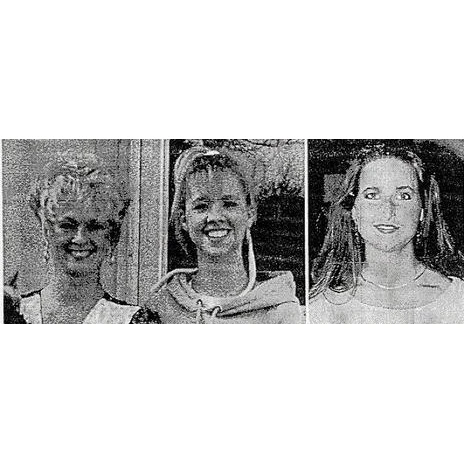
The Springfield Three: Three Women Vanished From One House and Left Everything Behind
Stacy McCall graduated from Kickapoo High School on the evening of June 6, 1992, and did what a lot of eighteen-year-olds do on graduation night: she went to parties with her friend Suzanne "Suzie" Streeter, who had graduated alongside her. The school had put together an alcohol-free lock-in that ran until eight the next morning, but the girls skipped it. They bounced between celebrations instead, and sometime around two in the morning, rather than heading to an overcrowded house where another friend was hosting people, they decided to spend the rest of the night at the home of Suzie's mother, Sherrill Levitt, on East Delmar Street in Springfield, Missouri. Sherrill, a forty-seven-year-old hairdresser, had spent her evening at home; she'd spoken to a friend on the phone around 11:15 p.m. about painting an armoire in her bedroom. Sometime after the girls arrived at the house, all three of them vanished. Nobody has ever been charged with anything connected to what happened to them, and more than three decades later, none of the three has ever been found.
A House With Nothing Missing But the People In It
When people who knew the women went looking for them the next day, the house told a story that made no sense on its own terms. Every car was still parked outside. Every purse was still inside, one of them containing almost nine hundred dollars in cash. Keys, driver's licenses, medication, cigarettes, jewelry, and even used makeup-remover wipes were all exactly where they should have been. Sherrill's bed looked slept in; her glasses sat on the nightstand beside a book that had been turned face down, the way someone leaves a book when they intend to pick it back up. There was no blood, no sign of forced entry, nothing overturned. The only physical evidence that anything violent might have happened at all was the glass globe of the porch light, found shattered on the ground outside, though the bulb inside it was somehow still intact.
The family's Yorkshire terrier, Cinnamon, was found in a state that people who were there still describe vividly decades later: agitated, crying, running frantically toward the first people who arrived, as though something had deeply frightened her. One investigator's working theory, offered years later, was that whoever came to the house may have taken the dog out into the yard during the night specifically so that returning her would give them a reason to be let back inside, a theory that explains the shattered porch light and the total absence of forced entry, though it was never proven.
There was one more piece of evidence that might have mattered more than anything else recovered from that house, and it was destroyed by accident before police ever heard it. The home's answering machine held a message investigators later described as strange, one they believed might have contained a real clue. Stacy's mother, Janis McCall, checked the machine while looking for any sign of where the girls had gone, and in doing so, erased it. Whatever was on that tape is gone permanently, a detail that still visibly frustrates investigators who worked the case in its earliest days.
A Crime Scene That Twenty People Walked Through
Compounding the loss of the answering machine message was a more basic problem: by the time anyone called the police, the scene had already been compromised. Somewhere between ten and twenty friends and family members had come and gone from the house looking for the women, moving through rooms, touching surfaces, before any formal investigation began. When officers were first alerted, the initial response was so unhurried that they reportedly left a note asking Sherrill to call them when she got back, not yet treating the situation as urgent. By the time investigators approached it as a real crime scene, whatever forensic evidence might once have existed inside that house had likely already been disturbed beyond recovery.
The Leads That Went Nowhere
Over more than thirty years, the Springfield Police Department says it has fielded upward of five thousand tips. Almost none of them have held up.
The most persistent name connected to the case is Robert Craig Cox, a convicted armed robber and kidnapper who had, by coincidence, once worked alongside Stacy's father. In 1997, from a Texas prison cell, Cox told a Springfield newspaper reporter that he knew the three women had been murdered and that their bodies would never be recovered. It was a chilling thing to say, and it got national attention, but Cox's own alibi for that night had already been independently confirmed by his parents, and a girlfriend who initially backed his account later said Cox had pressured her into lying for him. Investigators who worked the case have never treated him as a credible source, and Cox reportedly said he would only reveal more once his own mother had died.
A second name that surfaces regularly is Dustin Recla, Suzie Streeter's former boyfriend. Months before the disappearance, Recla and two accomplices had broken into a mausoleum and stolen gold fillings from a corpse, a crime Suzie had apparently given a statement to police about, making her a likely witness against him. Recla was in the area with those same accomplices on the night the women vanished. He has never been charged in connection with the disappearances, and the theory that this was retaliation for Suzie's cooperation with police has never moved beyond speculation, but it remains one of the more discussed threads in the case.
Multiple witnesses independently described an older, moss-green Dodge van in the vicinity that night. One account described a woman resembling Suzie apparently driving it while an unseen man's voice told her not to do anything stupid. Another witness claimed to have written down the van's license plate before ultimately throwing the paper away without calling police; under hypnosis years later, he could recall only three of the plate's characters. A separate witness reported seeing all three women at a nearby steakhouse in the early morning hours, with Suzie appearing intoxicated, though that sighting was never confirmed. Other residents in the area reported hearing screaming and screeching tires sometime in those same early morning hours. None of it ever connected into anything prosecutable.
Perhaps the strangest lead of all came at the very end of 1992, when a man called the America's Most Wanted tip hotline claiming direct knowledge of what had happened to the women. The call disconnected while the operator tried to patch him through to Springfield investigators, and despite public pleas for him to call back, he never did. Police later said the caller had appeared to have genuine, detailed knowledge of the abduction. He was never identified.
Digging Under a Parking Garage
The case took an unusual turn in 2007, when a local crime reporter named Kathee Baird arranged for a mechanical engineer to run ground-penetrating radar underneath the south parking garage of Cox Hospital, acting on an anonymous tip. The scan reportedly picked up three anomalies of roughly similar size and shape, two running parallel to each other and one perpendicular, consistent, in the engineer's assessment, with the size and layout of grave sites. It was a dramatic finding, and it briefly generated real hope. Springfield Police ultimately declined to excavate. The parking garage in question hadn't even begun construction until September 1993, more than a year after the women disappeared, and the original tip that prompted the search had come from a source who offered no real evidence or reasoning, reportedly someone who said the information had come to them in a dream. Without a stronger basis, the cost and disruption of tearing up a functioning hospital parking structure was judged not to be justified.
Three Names Still Missing
Sherrill Levitt and Suzanne Streeter were declared legally dead in 1997, five years after they disappeared, largely so their families could resolve estates and move forward with some form of legal closure. Officially, all three cases remain open as missing persons investigations, not closed homicide cases, a distinction that matters to the families still waiting for something conclusive. A memorial bench dedicated to the three women sits in Phelps Grove Park in Springfield.
Every June, local news outlets in Missouri still mark the anniversary. As of this June, it has been thirty-four years. The case has outlived some of the original investigators who worked it, generated true crime podcast episodes and television specials, and accumulated thousands of tips that have never once produced a body, an arrest, or a confirmed answer. What happened inside that house on East Delmar Street sometime after two in the morning on June 7, 1992 remains, after everything, exactly what it was on the first day anyone noticed something was wrong: three women, a shattered porch light, an erased phone message, and nothing else.
Sources
- The Charley Project — Stacy Kathleen McCall
- The Charley Project — Suzanne Elizabeth Streeter
- The Charley Project — Sherrill Elizabeth Levitt
- Wikipedia — Springfield Three
- FBI — The Springfield Three, Springfield, Missouri
- City of Springfield, Missouri — Three Missing Women
- KY3 — The Springfield 3: June 7 marks 34 years since the disappearance of Suzie Streeter, Sherrill Levitt, and Stacy McCall
- Newsweek — Three Women Vanished. More Than 30 Years Later, No One Knows What Happened
- NBC News Dateline — 30 years later family still seeking answers in the disappearance of three Springfield, Missouri women