The Polaroid in a Dead Man's Cell: Karen and Michael Reinert
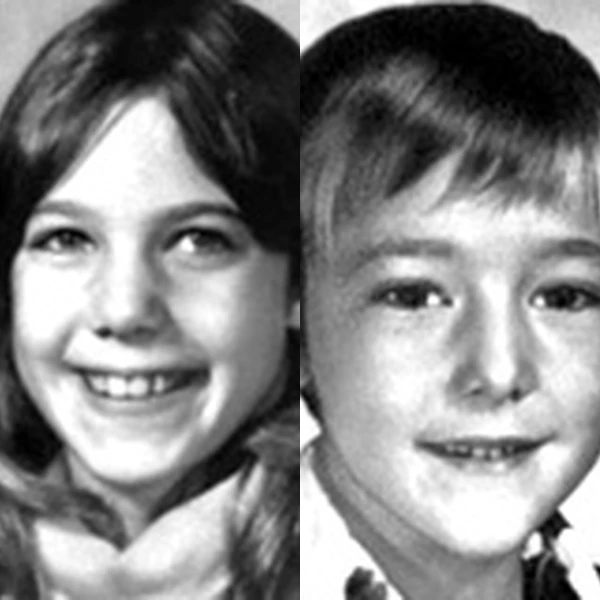
Karen Reinert was eleven years old, her brother Michael ten, when the two of them left their home in Ardmore, Pennsylvania at approximately 9:20 p.m. on June 22, 1979, and got into their mother's orange Plymouth Horizon hatchback. Their mother, Susan Gallagher Reinert, an English teacher at Upper Merion Area High School, told people she was driving the children to Allentown for a weekend gathering connected to Parents Without Partners, a support organization for single parents. None of the three of them were ever seen alive again by anyone outside whoever was actually responsible for what happened next.
Michael stood 4'2" and weighed 60 pounds, blond haired with blue or gray eyes, last seen wearing a red and white Philadelphia Phillies pullover t-shirt. Karen, a year older, has never had her physical description as fully documented in public records, though photographs from the time show a girl with a bright, easy smile. Three days after they disappeared, on June 25, 1979, Susan's body was discovered in the trunk of her own car in the parking lot of a motel in Harrisburg, roughly ninety miles from home. She had been beaten, bound with chain, and ultimately killed by a large injected dose of morphine. Her children were nowhere in or near the vehicle.
A Love Triangle at a Suburban High School
The investigation into Susan's murder quickly centered on two men connected to her through Upper Merion Area High School. William Bradfield taught in the English department alongside Susan, and the two of them had reportedly been planning to marry. About a month before her death, Susan had named Bradfield the sole beneficiary of a life insurance policy worth roughly half a million dollars, and he stood to inherit her estate, valued at another two hundred thirty thousand dollars, as well. The school's principal, Dr. Jay C. Smith, had a separate and more troubled connection to Susan, having reportedly made romantic advances toward her at some point that she rejected.
In the months leading up to Susan's murder, several of Bradfield's own colleagues and former students later testified to a grand jury that he had repeatedly told them, well before her death, that Susan was going to be killed by Jay Smith specifically, a pattern of statements that struck investigators as far more consistent with someone concealing advance knowledge of a planned murder than with any innocent premonition.
Two Trials, Two Very Different Outcomes
Prosecutors ultimately built their case around a theory that Bradfield had orchestrated Susan's murder, and her children's, to collect on the insurance money and estate, and to prevent her from discovering that he had secretly lost a substantial sum of money she had given him to invest on her behalf. Bradfield was tried in 1983 on conspiracy charges connected to the murders. While he was in custody, a fellow inmate reported that Bradfield had confessed details of how the crime had been planned. He was convicted and sentenced to life in prison, and he died there in January 1998, having never disclosed what had actually happened to Karen and Michael.
Investigators did not believe Bradfield had acted entirely alone, and in 1986 Jay Smith went to trial and was convicted on all three murder counts, receiving a death sentence and spending six years on death row. The physical evidence against him at trial included a green pin that Karen had reportedly been wearing the day she disappeared, found under the front passenger seat of Smith's own car, along with a blue comb inscribed with the designation of his military reserve unit, discovered near where Susan's body was found. It was a case that seemed, on its surface, conclusively closed.
A Conviction Undone
It did not stay closed. In 1992, the Pennsylvania Supreme Court overturned Smith's conviction entirely, citing serious judicial and prosecutorial misconduct during his trial. The court found that the trial judge had improperly allowed hearsay testimony from Bradfield's associates to be presented against Smith, and, more damning still, that prosecutors had withheld exculpatory evidence from Smith's own defense team, specifically sand recovered during Susan's autopsy that potentially corroborated an alibi location Bradfield himself had described. The Supreme Court characterized the prosecution's conduct as outrageous and ruled that retrying Smith under those circumstances would violate protections against double jeopardy, permanently barring any second trial regardless of what evidence might otherwise exist against him.
Smith walked free, though not entirely vindicated in the court of public opinion. His subsequent civil lawsuits against the Pennsylvania State Police and against author Joseph Wambaugh, who had written extensively about the case, both failed, with an appellate court noting pointedly that even setting aside the improperly admitted hearsay evidence, its confidence in the underlying case against Smith remained fully intact. Smith maintained his innocence for the rest of his life, remarried in 2002, and died of a heart condition on May 12, 2009, at eighty years old, buried afterward with full military honors.
A Family Already Touched by Disappearance
Jay Smith's own family carried an eerie, unrelated echo of the exact kind of tragedy he stood accused of causing. His daughter, Stephanie, and her husband, Edward Hunsberger, were reported missing back in 1978, a year before Susan Reinert's murder, after Smith told relatives the couple had relocated to California to escape drug dealers who were supposedly threatening them. Neither Stephanie nor Edward has ever been found, and the circumstances of their disappearance have never been fully explained, leaving Smith at the center of two separate, decades old mysteries involving people who vanished and were never recovered, one his own daughter, the other the children of the woman he was convicted, then un-convicted, of murdering.
A Photograph That Might Show a Grave
Karen and Michael Reinert were formally declared legally dead in 1987, eight years after they disappeared, without their remains ever being located. The case's strangest and most enduring lead did not surface until years after Bradfield's own death in 1998, when authorities searching through his belongings found a photograph, reportedly developed sometime around 1986, showing a stone marker standing upright in a wooded setting, positioned in a way that struck investigators as deliberate, as though marking a specific location rather than simply documenting scenery. The stone's shape, oddly, resembled a hooded figure. Investigators have long theorized that the photograph might depict the exact spot where Bradfield buried Karen and Michael, a private, almost taunting record he kept for himself and never explained, even from prison, even as his own life sentence stretched on for nearly two decades with no apparent benefit to keeping the secret any longer. Despite public appeals asking anyone who might recognize the specific wooded location in the photograph to come forward, the site has never been identified, and the theory has never advanced beyond speculation grounded in one unexplained image.
A Case That Became a Book, Then a Silence
The Reinert case became widely known well beyond Pennsylvania after journalist and author Joseph Wambaugh chronicled it in his book Echoes in the Darkness, which was later adapted into a two part CBS television miniseries in November 1987, with actor Robert Loggia playing Jay Smith. That level of public attention did nothing, in the end, to produce the one piece of information that mattered most to Karen and Michael's surviving family, where the two children actually were. Both men most closely tied to their mother's murder are now dead, one having died still formally convicted, the other having died formally exonerated by the state's own highest court, and neither one ever said a word, publicly or privately as far as anyone has ever confirmed, about what became of an eleven year old girl and her ten year old brother after they climbed into their mother's car on a June evening in 1979.
Still Unaccounted For
More than forty five years later, Karen and Michael Reinert remain among Pennsylvania's most enduring unsolved disappearances, a case that produced two trials, a landmark exoneration, a nationally broadcast dramatization, and ultimately nothing resembling an actual answer about where two children ended up. What survives is a single photograph of an unidentified stone in an unidentified patch of woods, discovered too late to ever be connected to a living, cooperating witness, and a family that has spent nearly half a century with nothing more concrete to hold onto than that.
Sources
- The Charley Project: Michael Reinert
- The Charley Project: Karen Reinert
- Wikipedia: Jay C. Smith
- Unresolved: The Main Line Murders, Part Three, Polaroid