New York's Oldest Missing Person: The Vanishing of Dorothy Arnold
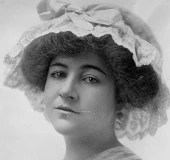
Dorothy Harriet Camille Arnold was twenty five years old on December 12, 1910, living with her wealthy family at their mansion on East 79th Street on Manhattan's Upper East Side. Her father, Francis Rose Arnold, had built a fortune importing perfume, and Dorothy herself had graduated from Bryn Mawr College with ambitions of becoming a professional writer, having already submitted short stories to magazines, all of which had been rejected. She stood somewhere between five foot one and five foot four, weighed between a hundred forty and a hundred sixty pounds, with dark brown hair and blue or gray eyes, and on the morning she vanished she was dressed in a tailor made blue serge suit, a long blue coat, lapis lazuli earrings, and a small black velvet hat trimmed in pale blue with two silk roses and a matching lapis lazuli pin.
That morning, Dorothy told her family she was going out to shop for a dress to wear to her younger sister's upcoming debutante ball. She left the house carrying somewhere between twenty five and thirty dollars in cash. She was spotted around 1:45 that afternoon at a candy store, and later that afternoon at Brentano's bookstore near Fifth Avenue and 27th Street, where she purchased a collection of essays and mentioned to an acquaintance that she planned to walk home through Central Park. She never arrived at a lunch appointment scheduled with her mother at the Waldorf-Astoria, and she never returned to the family mansion. Nobody outside her own family has ever reported seeing her again.
A Family That Hid Her Absence
Rather than immediately contacting police, Dorothy's family made the decision to hire private investigators first, hoping to locate her quietly and avoid the kind of public scandal a prominent New York family feared would come with a missing daughter making headlines. That delay meant days passed before any official search effort began, days during which whatever trail existed grew colder with each passing hour. When the family finally did involve police, and the case became public, it exploded into one of the most heavily covered disappearances in New York history, drawing hundreds of tips, an official reward of a thousand dollars, and enough sustained public fascination that it has remained, more than a century later, the oldest unsolved missing persons case on record in New York City.
A Secret Older Lover
As investigators dug into Dorothy's private life, they discovered she had been secretly involved with a much older man, George C. Griscom Jr., an engineer in his forties. Months before she disappeared, in September 1910, Dorothy had pawned some of her own jewelry to fund a secret weeklong trip to Boston, staying with Griscom at the Hotel Essex while telling her family she was visiting a college friend in Cambridge. At the time Dorothy vanished in December, Griscom was in Florence, Italy, and investigators never developed evidence connecting him directly to her disappearance, though the relationship itself, kept hidden from a family that almost certainly would have disapproved of the age difference and the deception involved, became one of the case's most closely examined threads.
Investigators also discovered that Dorothy had secretly rented her own post office box, apparently used to receive correspondence, including rejection letters from magazines and publishers, away from her family's oversight, another small indication of a young woman quietly building a private life her family knew little about.
The House of Mystery
Among the darkest theories to emerge from the case involved a possible pregnancy. One persistent line of speculation held that Dorothy had become pregnant, likely by Griscom, and had sought an illegal abortion that ended in her death. That theory gained disturbing new weight in 1916, six years after Dorothy vanished, when police uncovered an illegal abortion clinic operating out of the basement of a home in Bellevue, Pennsylvania, outside Pittsburgh, a facility that became notorious in the press as the House of Mystery after it emerged that multiple women who had visited it over the years had themselves gone missing afterward. A physician connected to the clinic, Dr. H.E. Lutz, later told the New York County District Attorney's office that a colleague, Dr. Meredith, had told him Dorothy Arnold had died there following complications from a procedure.
Dorothy's father never accepted that explanation. Francis Arnold called the abortion theory ridiculous and absolutely untrue, and held onto a very different belief about his daughter's fate for the rest of his own life. He told reporters at one point that he believed his daughter was dead, and that the one theory he had always leaned toward was that she had been kidnapped and made away with in a short time, a conviction he carried to his own grave without ever seeing it confirmed or disproven.
A Century of Speculation, No Resolution
Beyond the abortion theory and the kidnapping theory her father favored, investigators and armchair researchers alike have floated a wide range of other explanations across the decades since, including the possibility that Dorothy staged her own disappearance to escape a life and a family she felt suffocated by, that she died by suicide somewhere in Central Park or elsewhere in the city, or that her body was secretly buried in a New York cellar by someone connected to her either romantically or through the family's business dealings. None of these theories has ever been substantiated by any physical evidence, and the case has never come close to a definitive resolution in the more than one hundred fifteen years since Dorothy walked out of Brentano's bookstore and disappeared from recorded history.
Dorothy's own family has largely stepped back from public speculation about the case in recent years, reportedly having destroyed many of her personal letters at some point and preferring not to feed the kind of sensationalized theorizing that has surrounded her disappearance for well over a century. Her great-niece, Jane Vollmer, has spoken publicly about the family's perspective on the case, saying plainly that after a hundred years, she does not expect any resolution at all, a quietly resigned acknowledgment from someone several generations removed from Dorothy herself, still fielding questions about an ancestor nobody in the family ever actually knew.
Dorothy Arnold's case remains formally on record as New York City's oldest unsolved missing persons file, a distinction that has held for more than a century without any serious challenger. No trace of her, alive or dead, has ever been found, and the walk she mentioned taking through Central Park on an ordinary December afternoon in 1910 remains the last documented plan anyone ever heard her describe.
What has kept the case alive in public memory for so long is not simply its age but how thoroughly it resists resolution even now, with tools and forensic techniques available to modern investigators that nobody in 1910 could have imagined. There is no body to exhume, no crime scene to revisit, no DNA sample sitting in an evidence locker waiting for a familial match. Everything anyone will ever know about what happened to Dorothy Arnold exists only in the newspaper coverage, private investigators' notes, and family recollections gathered in the weeks and years immediately following her disappearance, material that was already secondhand and incomplete by the time reporters started publishing it. Each new generation of researchers who take up the case inherits the same fixed, finite set of facts her contemporaries had, with nothing new to add except fresh speculation layered onto an already century old mystery.
Sources
- The Charley Project: Dorothy Harriet Camille Arnold
- Wikipedia: Disappearance of Dorothy Arnold
- Morbidology: The Missing Heiress, Dorothy Arnold
- A&E: More Than a Century Later, An Heiress Is Still Missing
- All That's Interesting: The Case Of Dorothy Arnold, The New York Socialite Who Vanished
- Bored Panda: "I Don't Expect Any Kind Of Resolution", The 115-Year-Old Cold Case That Baffles New York
- Find A Grave: Dorothy Harriet Camille Arnold