A Bicycle in a Bean Field: The Disappearance of Arlin Henderson
Charles Arlin Leon Henderson, who went by his middle name Arlin, was eleven years old on July 25, 1991, living with his family in the Fountain N' Lakes subdivision near Moscow Mills, Missouri, a rural stretch of Lincoln County about fifty miles north of St. Louis. He was a small kid for his age, four foot five and seventy pounds, with a blond crewcut and blue eyes, distinguishing marks that included a scar on his thigh and a noticeable gap between his front teeth. That afternoon, sometime between five and five thirty, Arlin climbed onto his white and yellow bicycle and rode off near his family's mobile home wearing a camouflage print t-shirt, camouflage pants torn at one knee, gray socks with red stripes, and black sneakers. He never came home.
A Bicycle, Recovered Miles Away
For nearly three months, Arlin's disappearance had almost nothing attached to it beyond the fact that an eleven-year-old boy on a bicycle had simply vanished from a quiet rural subdivision in the middle of a summer afternoon. Then, on October 10, 1991, his bicycle turned up in a bean field roughly five miles north of his home, off N. Ethlyn Road, far enough away that it was clear he, or the bike itself, had traveled a real distance from where he was last seen. The discovery gave investigators a piece of physical evidence to work with, but it answered almost nothing about what had actually happened to the boy who rode it.
The case was classified as a non-family abduction, and Lincoln County investigators spent the following years working through what few leads existed in a case with no witnesses, no ransom note, and no body. Arlin's disappearance settled into the particular kind of limbo that surrounds so many missing children cases from the era before cell phones and widespread surveillance cameras, a story kept alive mostly through his family's persistence and the occasional renewed appeal from law enforcement.
A Man Nearby, and a Camera
One detail from the months before Arlin disappeared would later take on outsized significance because of who investigators eventually connected it to. According to accounts that surfaced later, one of Arlin's uncles had noticed a tall, thin man photographing the boy outside his school sometime before he went missing. Years afterward, several family members reportedly recognized that same man in photographs as Michael J. Devlin, the Missouri man who would go on to become nationally infamous in 2007 as the kidnapper who held Shawn Hornbeck and Ben Ownby captive for years in an apartment not far from where both boys had disappeared.
The connection was compelling enough that investigators formally looked into Devlin's possible involvement in Arlin's case once his crimes against Hornbeck and Ownby came to light in January 2007, when Hornbeck was found alive after more than four years in captivity and Ownby was recovered just days later, in the same apartment complex, having been held for only a matter of days. Devlin's crimes had unfolded within roughly a hundred miles of Moscow Mills, and the fact that he preyed specifically on young boys in rural and small-town Missouri made the earlier sighting near Arlin's school difficult for investigators to simply dismiss out of hand. In the end, though, authorities found no physical evidence or corroborating detail tying Devlin to Arlin's disappearance specifically, and the lead, however unsettling in its implications, went nowhere concrete. Devlin was already serving multiple life sentences by the time investigators closed out that avenue, meaning even a confirmed connection would have offered the Henderson family confirmation without the possibility of any new prosecution. It remains one of several threads in the case that investigators were never able to fully chase down to a resolution, a reminder of just how many different directions a single unsolved disappearance can pull an investigation over enough years.
A Confession That Was Actually a Joke
The most dramatic turn in Arlin's case came a decade after he vanished, in 2001, when a man named Joshua Spangler came forward and confessed to abducting and killing him. Spangler, who had been thirteen years old himself at the time Arlin disappeared, told investigators an elaborate story involving a man named Gibson who had allegedly paid him ten thousand dollars to kill Arlin as a warning connected to a debt someone in Arlin's family supposedly owed. Spangler's account implicated the Gibson brothers directly enough that authorities arrested them based on what he had told police.
It didn't hold up. As investigators pressed into the specifics of Spangler's story, discrepancies piled up, and in October 2001 authorities withdrew the charges against the Gibsons after concluding Spangler had fabricated his account of their involvement entirely. Spangler ultimately admitted the whole confession had been invented, describing it, according to investigators, as a malicious joke meant to make the police look incompetent. He pleaded guilty to perjury for the false statements he had given about Arlin's supposed death and was sentenced to seven years in prison, a real punishment handed down for what amounted to using a missing eleven-year-old boy as the setup for a prank on law enforcement. Investigators ultimately concluded that neither Spangler nor the Gibsons had anything to do with what actually happened to Arlin, leaving the case exactly where it had been before his confession, only with a decade more time having passed.
Tragedy Within the Family
Arlin's family endured a second devastating loss in the years following his disappearance. On March 10, 2000, his sister, Joy Henderson-Leonard, was murdered by her husband, Robert "Bob" Leonard, who then took his own life. For years this was treated publicly as a separate, unrelated family tragedy layered on top of the unresolved grief of Arlin's disappearance, two terrible things that happened to the same family rather than two connected pieces of a single story.
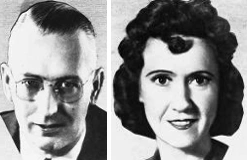
That changed as investigators revisited the Henderson case decades later. By 2023, the Lincoln County Sheriff's Office had come to believe that Joy and Bob Leonard may have possessed crucial information related to Arlin's disappearance before their deaths, information that, if it ever existed, died along with them in that 2000 murder-suicide. The sheriff's department began actively seeking out anyone who had known the couple, hoping someone in their orbit might hold a piece of whatever they knew, a friend they had confided in, an offhand comment at a family gathering, anything that might have been dismissed as insignificant at the time it was said. Investigators have not publicly detailed what led them to suspect Joy and Bob specifically, whether it grew out of new forensic review of the original case file, a tip from someone who had known the couple, or simply the accumulated instinct of detectives who had spent years living with every angle of the Henderson file. What is clear is that the theory transformed how the sheriff's department approached the case, shifting the active search for answers away from strangers like Devlin and fabricators like Spangler and toward the family's own inner circle instead.
It is a genuinely unusual and painful theory for a family to have to sit with, the possibility that the answer to what happened to their son may have been known all along by two other family members who are no longer alive to tell it. It means that somewhere in the nine years between Arlin's disappearance and his sister's murder, Joy and her husband may have carried knowledge about the worst thing that ever happened to their family without ever passing it on to the people who needed it most, whether out of fear, complicity, or some other pressure investigators can now only guess at from a distance of decades.
Still Waiting, More Than Three Decades Later
Arlin's mother, Deborah Henderson, has remained in the same trailer park in Lincoln County in the decades since her son disappeared, continuing to hold onto hope for answers even as those decades have piled up without them. Speaking to local reporters during the 2023 renewed push for tips, she said simply that there was not a day that went by that she didn't think of her son, a sentence that carries the particular, specific weight of thirty-two years of unresolved waiting.
Arlin's father died of emphysema in 1990, less than a year before his son disappeared, meaning he never had to live through any part of the search for his missing boy. Arlin's case remains open and unsolved with the Lincoln County Sheriff's Office, which has also continued working the separate cold case of Bianca Piper, another Lincoln County resident who went missing in 2005. The bicycle recovered from that bean field back in October 1991 remains one of the only physical traces of Arlin ever found, and more than three decades after he pedaled away from his family's mobile home on a summer afternoon, no one has ever been charged, and Arlin himself has never been found.
Sources
- The Charley Project: Charles Arlin Leon Henderson
- Wikipedia: Disappearance of Charles Arlin Henderson
- CrimeOnline: Police seek tips on missing Missouri boy who disappeared in 1991, possible connection with sister's brutal murder
- First Alert 4: 32 years after 11-year-old's disappearance, Lincoln County Sheriff continues working to unravel mystery
- KSDK: Investigators seeking help in Lincoln County cold case from 1991