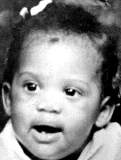
The Empty Stroller on Baltic Avenue: The Disappearance of Bonita Karen Sanders
Bonita Karen Sanders was born on September 17, 1984, and by the time she disappeared three days before what would have been her second birthday, she had already lived through more instability than most children face in a lifetime. Her mother, also named Bonita, reportedly walked out of an Atlantic City hospital shortly after giving birth to her in 1984, leaving the newborn behind at the facility. Whatever happened in the two years that followed, Bonita Karen ended up back in her mother's custody, living with her at the Virginia Court Apartments in the 900 block of Baltic Avenue in Atlantic City, New Jersey, along with her siblings. Bonita Karen went by the nickname Nita, had black hair and brown eyes, stood somewhere between two feet and two and a half feet tall, weighed between twenty and thirty pounds, and had a slightly deformed left hand that curved inward, along with an abdominal hernia scar and a scar on her wrist. She was left handed.
An Empty Stroller
On the evening of September 14, 1986, Bonita Karen was strapped into her stroller on the porch of the family's apartment while her siblings and other neighborhood children played outside around her. Around six o'clock, she was described as sitting there eating a popsicle, an unremarkable, almost idyllic detail from an otherwise ordinary evening in a working class Atlantic City neighborhood. Her mother looked out at some point around seven o'clock and discovered that the stroller was empty. Bonita Karen was gone. Rather than immediately raising an alarm, roughly ninety minutes passed before her mother reported the child missing to police at approximately 8:30 that night, a delay that would later strike investigators as one of many details in the case that did not add up.
Police moved quickly to identify and eliminate potential suspects. Bonita Karen's father, a man named Abdul Salaam, was ruled out early in the investigation, in large part because he was incarcerated at the time she vanished and could not have been physically responsible for whatever happened to her. That left investigators looking hard at the only adult who had been present when the child disappeared from a porch full of playing children in broad view of a residential street: her own mother.
A Pattern That Could Not Be Ignored
What made the case so disturbing to investigators was not simply the disappearance itself but the pattern of behavior surrounding it, both before and after. Bonita Karen's mother had already tried to abandon her once, at the hospital immediately following her birth. Then, in October 1986, just weeks after Bonita Karen vanished from the porch, her mother checked into Atlantic City Medical Center under a false name, Laura Smith, and gave birth to a baby boy. On October 7, 1986, she and the newborn were discharged from the hospital together. Instead of taking him home, she left the infant alone, lying face down in a restroom at a bus terminal, and boarded a bus bound for Philadelphia, Pennsylvania. The baby was found and survived, but the incident left investigators with a documented, repeated pattern of a mother abandoning her own newborn children within the same narrow window of time that her one-year-old daughter had vanished without a trace.
She was later convicted of endangering the welfare of a child in connection with the bus terminal incident and served time in prison, more than once over the years that followed. Throughout the ongoing investigation into Bonita Karen's disappearance, investigators found her mother uncooperative and inconsistent, describing the leads she offered to police as false and contradictory. Perhaps most tellingly, those working the case noted that she never once reached out on her own to ask about the investigation's progress or whether there had been any update in the search for her missing daughter, the kind of silence that read less like grief and more like a woman who already knew there was nothing left to find.
A Search That Turned Up Nothing
The case went cold for more than two decades, an infant's disappearance from a busy residential porch with no leads that ever produced a body or a conviction. Then, in February 2009, more than twenty two years after Bonita Karen vanished, new information reportedly came from an acquaintance of her mother's, pointing investigators toward a specific location: a wooded area across from the Pleasantville Recreation Center, not far from where the family had lived in 1986. Atlantic City authorities organized a search of that site, digging through the wooded ground in hopes of finally recovering some physical trace of the child who had disappeared so many years before. The search turned up nothing. No remains were found, and the case returned to the same unresolved status it had occupied for over two decades.
Bonita Karen's mother died in 2010, taking with her whatever specific knowledge she may have carried about what actually happened on that September evening in 1986. Investigators have stated publicly that they now believe Bonita Karen died on the very day she disappeared and that her body was hidden or buried somewhere in the aftermath, a conclusion built less on any single piece of forensic evidence than on the totality of a mother's documented history of abandoning her children, her inconsistent statements to police, and the simple absence of any credible sighting of a toddler who would have been instantly recognizable to anyone who knew the family or the neighborhood.
The case remains formally classified as an unsolved, open investigation, still handled by the Atlantic City Prosecutor's Office through its Major Crimes Unit. Officially, it carries the designation of a non-family abduction, a classification more procedural than descriptive of what investigators actually believe took place. There is no indication that anyone was ever formally charged in connection with Bonita Karen's death or disappearance, and with the person investigators considered their central figure of interest now dead for over a decade, the odds of the case producing a courtroom resolution of any kind have grown vanishingly small.
What remains, nearly forty years later, is the same unanswered question that has defined the case from its earliest hours: what happened on that porch on Baltic Avenue between the moment a one-year-old girl sat eating a popsicle in her stroller and the moment her mother looked outside to find the stroller empty. If Bonita Karen Sanders were alive today, she would be in her early forties, old enough to have lived a full adult life that instead ended, according to the people who have spent decades investigating her case, sometime within the same few hours in September 1986. Her remains have never been recovered, and the wooded ground near Pleasantville that investigators once searched in hope of finally bringing her home gave up nothing at all.
A Sister Left Waiting
For the siblings who grew up alongside Bonita Karen in that Atlantic City apartment and who were playing outside with her on the porch the evening she vanished, the decades since have brought little beyond a slow accumulation of frustration layered on top of grief. A sister who has spoken publicly about the case over the years has described watching hope rise with each new tip or search, only to see it collapse again when nothing came of it, the 2009 search near Pleasantville among the more painful examples of a promising lead amounting to nothing more than an afternoon of digging in the dirt. Investigators created an age-progressed image of what Bonita Karen might have looked like at nineteen, part of an ongoing effort by the National Center for Missing and Exploited Children to keep her case visible even as the physical evidence trail went nowhere, a rendering of a grown woman built from a photograph of a one-year-old who never had the chance to become her.
The case is still catalogued across multiple databases meant to keep unsolved disappearances from disappearing themselves: NamUs, the Doe Network, and the missing persons registries maintained by both state and federal agencies, each carrying the same handful of identifying case numbers, Atlantic City police case 114-86, NCIC case M-106963744, and NCMEC case 601887, numbers that exist because a filing system needed something to attach to a child nobody could locate. Every one of those listings still describes her the same way she looked the last time anyone outside her immediate family saw her, a small girl in a yellow short-sleeved shirt and blue pants, blue and white sandals on her feet, sitting in a stroller on a porch in Atlantic City on an otherwise unremarkable September evening.
Anyone with information about Bonita Karen Sanders is asked to contact the Atlantic City Prosecutor's Office, Major Crimes Unit, at 609-645-7700, or the National Center for Missing and Exploited Children at 1-800-843-5678.
Sources
- The Charley Project: Bonita Karen Sanders
- The Resource Center for Cold Case Missing Children's Cases: Bonita Karen Sanders
- National Center for Missing & Exploited Children: Have You Seen This Child? Bonita Sanders
- 411gina.org: Missing, Bonita Karen Sanders
- Fox News: New Evidence in Case of N.J. Toddler Missing for 22 Years
- The Press of Atlantic City: From hope to frustration for sister of girl missing in 1986