Gone at the River: The Disappearance of Sandra and John Jacobson
On the evening of November 16, 1996, Sandra Mary Jacobson left her parents' home in Bismarck, North Dakota, with her five-year-old son John Henry Jacobson, telling her family she was going to get gas before agreeing to check herself into a hospital for a mental health crisis that had been building for days. She never got there. Sometime that night, her gray 1990 Honda Civic came to rest in the parking lot at Centennial Beach along the Missouri River, driver's door standing wide open, keys still in the ignition, her purse sitting undisturbed on the front seat. Sandra and John were gone, and neither has ever been found.
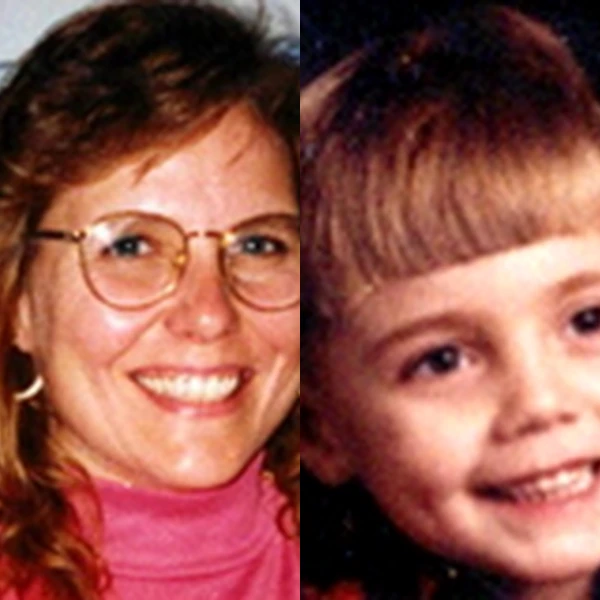
Sandra was 36 years old, a white woman standing 5'6" with brown hair, green eyes, and a habit of wearing eyeglasses, known to nearly everyone who loved her as Sandy. John, born August 12, 1991, was a small boy for his age at 4'8" and 75 pounds, with light brown hair and brown eyes, last seen wearing a hunter green winter coat with blue cuffs. He was the kind of five-year-old who tied a towel or a blanket around his neck like a cape and ran through the house pretending to be a superhero. His sister-in-law would later remember that he and her own daughter were inseparable, best friends who loved each other completely. Sandra, for her part, was the family member who made sure everyone showed up for the holidays. Gatherings were her thing, and she wanted the whole family together, having fun, whenever she could arrange it.
A Call About a Cult
In the hours before she disappeared, Sandra placed a call to the Bismarck Police Department from her cellular phone. She was distraught, and she told the officer who answered that satanic ritual abuse was taking place on a farm near Center, North Dakota, the small town where she and John had been living in a trailer. She said she did not trust the local authorities in Center or in Oliver County, which was why she was calling Bismarck instead. The responding officer's report on the call was thin, offering little detail about who Sandra believed was in danger or what specifically she claimed to have witnessed. Years later, when a cold case investigator went looking for the actual audio recording of that call, hoping it might reveal something the written report had missed, he discovered the recording no longer existed. It had been destroyed, and with it went whatever tone, hesitation, or specific accusation might have been audible in Sandra's own voice that night.
Family members later described Sandra as someone who had cycled through periods of religious preoccupation and fear about the end of the world. Her first husband, Vernon Nastrom, told investigators she had once discussed an apocalyptic pact with him, an agreement that if certain signs appeared, the two of them would jump from Memorial Bridge together. He said her convictions on the subject were not fixed. She moved in and out of these fears over the years, and at other points she rejected the idea of suicide outright on religious grounds, believing it would cost her her soul. Whatever combination of fear, faith, and crisis was moving through her that November evening, it was serious enough that she had agreed, before leaving her parents' house, to go to the hospital.
Left Behind at the River
Sandra and John were reported missing at 10 p.m. that same night, November 16, after they failed to return from what should have been a short errand. Their car turned up the following morning in Bismarck's Centennial Park, close to the Missouri River. Beyond the open door and the keys left in the ignition, investigators noted something else that stood out: Sandra's driver's license was missing from her purse, even though her checkbook and financial cards had been left behind untouched. It was a small detail, but an odd one, the kind of inconsistency that neither confirmed nor ruled out any particular explanation for what had happened at that parking lot.
The Bismarck Police Department's original investigation leaned heavily on Sandra's documented mental health struggles and settled fairly quickly on the theory that she had walked into the Missouri River, possibly after harming John first. The North Dakota National Guard was called in more than once to search the area from the air, while dive teams worked the river in brutal winter conditions. No trace of either Sandra or John was ever recovered from the water. In May 1997, a child's shoe was found near the park, and for a moment it seemed like it might be the first physical evidence connecting the abandoned car to what had actually happened to John. But when investigators showed it to family members, John's older half-brother and his grandmother both said the shoe looked too large to have belonged to a boy his size. Sandra's estranged husband, Alan Jacobson, took the opposite position, telling investigators it could well have been his son's. The disagreement was never resolved, and the shoe's origin remains uncertain to this day.
A Marriage Coming Apart
Sandra had separated from her second husband, Alan Jacobson, about three months before she disappeared, and she and John had been living together in a trailer in Center, along with Sandra's 16-year-old son from her first marriage, Spencer Nastrom. Sandra told her family she believed she and Alan were headed for divorce, and that she was worried about how a custody fight over John might unfold. Alan told a different story. He said the two of them were reconciling, and that they had even begun attending couples counseling together through the employee assistance program at Sandra's job with the North Dakota Department of Transportation.
When a cold case detective, Sergeant William Connor, picked the file back up years later and subpoenaed the relevant records, he found no evidence that Alan had ever actually attended a counseling session, and no record at the courthouse of any divorce proceeding having been filed by either spouse. Alan had also initially denied having had any affair during the marriage, only later admitting to one that occurred earlier, around the time he and Sandra had first separated. He had previously described Sandra's accusations about his fidelity as off the wall conspiracy theories.
Other details accumulated as well. A $30,000 life insurance policy on Sandra named Alan as the beneficiary, and he eventually collected that payout roughly five years after she vanished, telling investigators the money was meant to cover administrative costs related to the case. Phone records showed that Sandra had called a Bismarck life insurance company twice in the hours before she disappeared. Alan dismissed the calls as a misdial when asked about them, an explanation Connor did not find especially convincing given the timing. Days after Sandra went missing, the human resources director at her workplace reported that Alan had come in and been rather aggressive in asking about her employment benefits. He also declined to provide a DNA sample that could have been used to help generate an age-progressed image of John for missing children's organizations, despite understanding that his sample might aid the search, and at one point falsely claimed he had already sent childhood photos of John to one such organization when in fact investigators had obtained those images directly from Sandra's own family.
Perhaps the most striking piece to emerge involved Sandra's wedding rings. Spencer, her teenage son, told investigators that days after his mother and younger brother disappeared, he saw Sandra's wedding rings sitting in a container of loose change inside Alan's home. Alan was never able to offer an explanation for how the rings had come to be there. When Connor eventually asked Alan to submit to a polygraph examination, Alan's attorney declined on his behalf. Alan also claimed to have been away on a business trip in Missouri at the time of the disappearance, an alibi that the original 1996 investigation never fully verified. A detective at the time confirmed only that Alan had stayed at a specific hotel on November 17, the day after Sandra and John vanished, without ever pinning down where he had actually been the night before. A coworker later submitted a handwritten letter claiming the two of them had traveled together, but that account was apparently never followed up with a direct interview.
None of this amounted to an arrest or even a named suspect. Police have stated plainly, both at the time and in the years since, that they have no evidence of foul play in the case and have never identified a suspect in the disappearance of either Sandra or John. But the pattern of Alan's behavior, taken together, was enough to keep his name attached to the case long after the original investigation wound down.
The Diary That Was Never Found
Sandra's family remembered her as someone who kept a detailed daily journal, writing in it consistently and treating it, along with her purse, as one of the few items she considered essential to carry through her daily life. That journal was never recovered. By the time Sergeant Connor took over the case in 2004, Alan had already sold the trailer where Sandra and John had been living, and whatever became of the diary during that process was never established. Connor later said that having the journal in hand, even years after the fact, would have given him something concrete to work from, some fuel for the investigation rather than the secondhand recollections and disputed timelines he was left piecing together instead. Without it, one of the only records of exactly what Sandra was thinking and fearing in the days and weeks leading up to November 16, 1996, simply vanished along with her.
The original 1996 investigation, led by Detective Tim Turnbull, drew criticism when it was later reviewed for how quickly it settled on the river theory and how loosely it verified some of the basic facts of the case. Sandra's car was never fingerprinted, despite an early theory that a third person might have been present when it was abandoned. Alan was permitted to retrieve Sandra's purse from police custody, and eventually the car itself, without the kind of formal evidence documentation that a more skeptical investigation might have insisted on. Turnbull officially closed the case as inactive on February 23, 1999, writing that there were no further leads to pursue, a little more than two years after Sandra and John were last seen.
An Ex-Husband's Own Unsolved Murder
One more thread runs through this case, tangled and unresolved in its own right. Vernon Nastrom, Sandra's first husband and the father of her older son Spencer, was interviewed early on about Sandra's disappearance and passed a polygraph examination, after which investigators dropped him from consideration as a suspect. In 2005, nine years after Sandra and John vanished, Vernon himself became a homicide victim. He was run over by his own vehicle and left to die in a ditch along a maintenance road north of Tuttle, North Dakota. His murder has never been solved either, an unsettling coincidence that has never been definitively tied to the Jacobson case but that has never been fully ruled out as connected either.
Still Missing
Both Sandra and John have since been legally declared dead, a formality that closes an estate but answers nothing about what actually happened to them at Centennial Beach on that November night in 1996. Investigators who have revisited the file over the years have found a case shaped as much by what was lost as by what was found: a destroyed 911 recording, a diary that disappeared with a trailer sale, a child's shoe nobody could agree on, and an alibi that was accepted rather than verified. The leading theory offered by the original investigation, that Sandra took her own life in the river and took John with her, has never been supported by any physical evidence recovered from that water despite extensive searching. Whether Sandra and John are still somewhere in the Missouri River, whether they met a different fate at the hands of someone else entirely, remains exactly as unresolved today as it was the winter morning a deputy found an empty car with the door standing open at the edge of the park.
Sources
- The Charley Project: Sandra Mary Jacobson
- The Charley Project: John Henry Jacobson
- InForum: Jacobson disappearance, Part 1 - Police file reveals flawed 1996 investigation into missing ND mother and son
- InForum: Jacobson disappearance, Part 2 - Police file reveals suspicion fell on husband in 1996 North Dakota case
- Duluth News Tribune: Jacobson disappearance, Part 3 - Missing diary could shed light on vanished North Dakota mother and son
- InForum: Jacobson disappearance, Part 4 - Remembering Sandra and John
- InForum: Missing - Sandra and John Jacobson, Nov. 16, 1996