Twenty-Five Years in His Own Backyard: The Murder of Kristin Smart
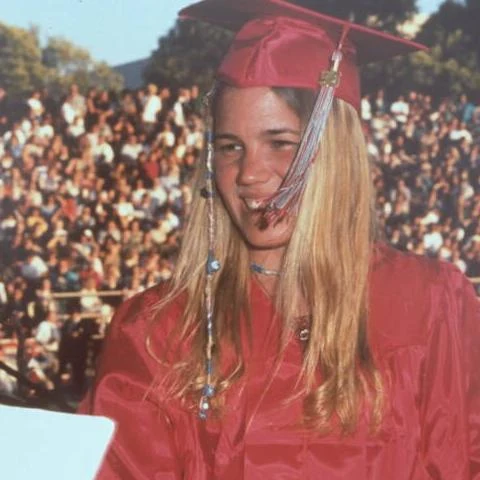
Kristin Smart was nineteen years old and finishing her freshman year at California Polytechnic State University in San Luis Obispo when she disappeared over Memorial Day weekend in 1996. She had grown up in Stockton, California, the daughter of two teachers who had worked with American military families, born while the family was stationed in Bavaria. She graduated from Lincoln High School in 1995, spent time working as a lifeguard and camp counselor in Hawaii, and arrived at Cal Poly as an architecture major with the kind of ordinary, forward-looking momentum that makes what happened to her feel even more senseless in retrospect. On the night of May 24 into the early morning of May 25, 1996, she walked away from a party with a fellow freshman named Paul Flores, and she was never seen again. It would take twenty-five years, a true crime podcast with millions of downloads, and ground-penetrating radar aimed at a stranger's back deck before anyone was held responsible.
The Last Night
Kristin had gone, largely alone, to an off-campus party she wasn't especially familiar with. Sometime around two in the morning, other students found her passed out on a neighbor's lawn nearby. Two of them, Cheryl Anderson and Tim Davis, started walking her back toward her dorm, Muir Hall. Paul Flores, who had also been at the party, joined the group partway and told Anderson he'd take over escorting Kristin the rest of the way, since his own dorm, Santa Lucia Hall, was closer to their route. Anderson and Davis peeled off, leaving Kristin in Flores's company. According to the account Flores later gave police, he walked her only as far as his own dormitory and then let her continue on alone from there. Nobody else ever reported seeing her again. She had no money and no credit cards with her that night. Her room at Muir Hall, when anyone finally checked, was undisturbed, as though she had simply never made it home to disturb it.
University police were slow to treat her absence as urgent. Investigators initially floated the idea that Kristin had simply taken an unannounced trip somewhere, and despite her family's calls, it took roughly a week before she was formally reported and treated as missing. Early searches, using volunteers, horseback search teams, and ground-penetrating radar, turned up nothing. In one of the case's stranger footnotes, an earring that may have belonged to Kristin was found at a former residence of Paul Flores's mother, but it was never properly logged as evidence and was later lost entirely, a small but telling illustration of how badly those first years of investigation were handled.
A Bruise, and Two Decades of Silence
In the days after Kristin vanished, people who saw Paul Flores noticed a visible bruise around one of his eyes. He offered different, inconsistent explanations for it over time. Cadaver dogs, brought in to search his dorm room, showed interest in his mattress, though nothing conclusive was recovered from it at the time. Between 1996 and 2007, the FBI and local investigators searched properties connected to the Flores family more than once, without success. At one point, because the timing coincided with Scott Peterson's own connection to Cal Poly during the Laci Peterson case, investigators briefly looked at Peterson too, before ruling him out entirely.
For roughly twenty-five years, Paul Flores said almost nothing. He invoked his Fifth Amendment right against self-incrimination whenever pressed, gave no cooperation, and lived what appeared, from the outside, to be an unremarkable life while the case around him went cold, then colder, then sat for years as one of California's most recognizable unsolved disappearances, discussed at candlelight vigils and in occasional news retrospectives but without any real forward motion.
The Podcast That Restarted Everything
What finally broke the silence wasn't a new piece of forensic technology or a deathbed confession. It was a podcast. In September 2019, a producer named Chris Lambert launched a series called Your Own Backyard, dedicated entirely to reexamining Kristin's case episode by episode, with the blessing of her parents. It went on to generate more than thirty million downloads and did what two decades of official investigation apparently hadn't: it got people talking again, pulled in new witnesses who hadn't previously come forward, and put public pressure back on a case that had drifted toward permanent cold status. A new billboard went up in Arroyo Grande in January 2020, and within weeks investigators were moving in ways they hadn't in years.
On January 29, 2020, two trucks belonging to Flores were seized as evidence. On February 5, search warrants were served simultaneously at four separate locations, in San Luis Obispo, in Washington State, and in Los Angeles County, and Flores himself was briefly detained. In April 2020, reporting revealed that investigators searching Flores's home in San Pedro had found what were described as items of interest, including date rape drugs and homemade videos depicting sexual assault, material that, whatever else it proved, did nothing to help his case in the court of public opinion even before any murder charge had been filed.
What the Radar Found
The turning point came at the home of Paul's father, Ruben Flores, in Arroyo Grande. Investigators using ground-penetrating radar and cadaver dogs found evidence consistent with human remains having once been buried beneath Ruben's back deck, remains that appeared to have been exhumed and moved sometime before investigators got there. On March 15, 2021, a related search warrant led to a 1985 Volkswagen Cabriolet, also connected to the property, being towed away after cadaver dogs alerted to it as well.
On April 13, 2021, almost exactly twenty-five years to the day since Kristin disappeared, both Paul and Ruben Flores were arrested. Paul was charged with murder. Ruben was charged as an accessory after the fact, accused of helping his son hide and later relocate Kristin's body. San Luis Obispo County District Attorney Dan Dow acknowledged publicly that the statute of limitations had already expired on any sexual assault charge connected to that night, but argued that a killing committed in the course of an attempted rape still supported a first-degree felony murder charge against Paul regardless of how much time had passed.
The Trial
The case was moved out of San Luis Obispo entirely, to Monterey County Superior Court in Salinas, after a successful defense motion argued that decades of local media coverage made a fair local jury impossible. Judge Jennifer O'Keefe presided over a trial that began in June 2022 and ran for nearly three months, drawing on more than 1,500 jury summonses to seat two separate juries, one for Paul and one for Ruben, hearing the same evidence simultaneously but reaching independent verdicts.
Prosecutors argued that Paul had killed Kristin during an attempted rape in his dorm room that night, and that Ruben had later helped dispose of and eventually relocate her body once suspicion started closing in decades later. On October 18, 2022, the two juries returned split verdicts: Paul was found guilty of first-degree murder. Ruben was acquitted of the accessory charge. During Ruben's jury's deliberations, one juror was dismissed and replaced after disclosing that he had been discussing the case with his priest for spiritual guidance, unable to handle the stress of the deliberations on his own. Paul was sentenced on March 10, 2023, to twenty-five years to life in prison.
No Body, Even Now
Kristin's remains have never been recovered, despite everything the radar and the dogs and the exhumed patch of ground beneath Ruben Flores's deck seemed to suggest. She was declared legally dead in 2002, nineteen years before anyone was ever arrested in connection with her death. Paul Flores has been attacked twice by other inmates using improvised weapons since his conviction, first at Pleasant Valley State Prison, and is now held at California State Prison, Corcoran. His appeals have not succeeded: an unpublished appellate decision affirmed his conviction in October 2025, and the California Supreme Court declined to review the case in January 2026. Absent some unexpected federal intervention, he will not be eligible for parole before 2047.
Even that hasn't closed the book entirely. In early May 2026, thirty years almost to the month since Kristin disappeared, investigators returned to Susan Flores's property in Arroyo Grande, Paul's mother's home, and conducted another search using ground-penetrating radar, taking soil samples that reportedly suggested the possible presence of human remains. As of that search, nothing had been definitively recovered, and detectives were said to still be analyzing what they'd collected. Three decades on, the case that a podcast helped drag back into the light is still, in the most literal sense, unfinished: a conviction stands, a sentence is being served, and Kristin Smart's family is still waiting for somewhere to bring her home to.
What Changed Because of Her
Kristin's disappearance did leave one concrete, lasting mark on California law well before her killer was ever identified. In 1998, two years after she vanished, the state legislature passed the Kristin Smart Campus Security Act, sponsored by State Senator Mike Thompson and passed by a unanimous 61-0 vote, signed into law by Governor Pete Wilson that August. The law requires California's public colleges and other publicly funded educational institutions to establish formal agreements between campus security and local police departments specifically covering how violent crimes and missing student reports get communicated and handled, a direct response to the way Cal Poly's own campus police had treated Kristin's disappearance in 1996, as a curiosity rather than an emergency, in the earliest and most critical days when time still mattered.
Sources
- The Charley Project — Kristin Denise Smart
- Wikipedia — Murder of Kristin Smart
- CBS News — A timeline of the Kristin Smart case, and Paul Flores' conviction for her 1996 murder
- NPR — Paul Flores, convicted of killing Kristin Smart, is sentenced 25 years to life
- CNN — 30 years after Kristin Smart vanished, a new search renews hope for answers
- County of San Luis Obispo — Paul Flores' Petition for Review of his Conviction Denied by California Supreme Court
- All That's Interesting — Kristin Smart Disappeared Without A Trace In 1996. Nearly Three Decades Later, A Podcast Helped Bring Her Killer To Justice
- ABC News — Kristin Smart case: Former classmate arrested in 1996 disappearance of Cal Poly student