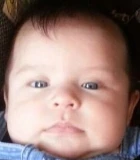
A Pillow Over Her Face: The Death of Baby Janna Rivera
Janna Rivera was three months old in May 2015, living with her mother, Yolanda Rivera-Gonzalez, and her mother's boyfriend, Jeffrey D. Fairbanks, in the Orchard Valley Farms subdivision on Candy Apple Boulevard in Indianapolis, Indiana. She was biracial, White and Hispanic, with brown hair and blue eyes, an infant barely old enough to hold her own head up steady, dressed in nothing more than a shirt and a diaper on the last day anyone outside her household ever saw her.
On the morning of May 29, 2015, Yolanda called 911 and told the dispatcher her infant daughter was dead. Minutes later, she called back and recanted that story entirely, offering a completely different account: that her boyfriend, Jeffrey Fairbanks, had taken Janna the night before and that she had no idea where either of them had gone. That shift, from a direct claim that her own baby had died to a story about the child simply being taken somewhere unknown, set off an urgent search effort and, before long, a homicide investigation that would stretch on for years without ever producing the one thing Janna's family needed most.
A Story That Kept Changing
When police located and questioned Jeffrey Fairbanks, they found him intoxicated, and the account he eventually gave them shifted over the course of the investigation. In one version, he said he had woken up around 1:30 that afternoon and discovered Janna unresponsive, apparently having died of natural causes sometime while she slept. In a later, far more disturbing account, Fairbanks admitted that he had wrapped Janna's body in a blanket and driven around for hours before ultimately disposing of her in a dumpster at the nearby Maison Garden Apartments, a confession that sent investigators into an extensive search of the local waste stream, checking garbage trucks and area landfills in hopes of recovering her remains before they could be lost entirely to the ordinary churn of a sanitation system.
Investigators also recovered a bloodstained blanket connected to the case, physical evidence that supported the darker version of events even as it stopped short of proving conclusively what had actually happened inside that home before Janna died. According to court documents that later surfaced, Fairbanks had a documented pattern of covering Janna's face with a pillow in an effort to stop her crying, a detail that painted a picture of ongoing mistreatment stretching back well before the day she actually died, rather than a single isolated tragedy. A protective order connected to the case also indicated that Fairbanks had told Yolanda directly that Janna was dead and that he had buried her, a statement that conflicted with his own later account of disposing of her body in a dumpster instead.
A Trial Built Without a Body
Despite months of searching that stretched across garbage trucks, transfer stations, and area landfills, Janna's remains were never recovered. Prosecutors nonetheless moved forward, charging Fairbanks with murder and neglect of a dependent, building a case around his own shifting statements, the bloodstained blanket, the documented pattern of covering her face with a pillow, and his prior criminal history, which included a 2013 domestic battery conviction involving his ex-wife.
The trial took place in April 2017, spanning three days of testimony and argument. Prosecutors laid out their case for murder, but the jury was not fully persuaded. After less than two hours of deliberation, jurors returned a verdict that split the difference in a way that left Janna's family with a deeply mixed outcome: not guilty of murder, but guilty of neglect of a dependent resulting in death. Fairbanks's defense attorney expressed disappointment with even that partial conviction and indicated an intention to appeal the verdict.
Thirty Years, No Grave
Fairbanks faced a potential sentence ranging from twenty to forty years in prison on the neglect conviction. He was ultimately sentenced to thirty years, a substantial term though one that fell well short of what a murder conviction would have carried, and one that left Janna's family and the broader Indianapolis community with an uncomfortable, unresolved question about what exactly had happened inside that home in the hours before Janna died, and whether neglect alone fully captured it.
Fairbanks appealed his conviction, taking the case through Indiana's court system and eventually attempting to bring it before the United States Supreme Court, though the underlying conviction and sentence ultimately stood. Throughout the appeals process and in the years since, Janna's body has never been recovered, meaning that even with a man convicted and sentenced specifically in connection with her death, there remains no confirmed physical resting place for her at all.
An Investigation That Never Fully Closed
Janna Rivera's case remains listed as an active missing persons matter even though the person responsible for concealing what happened to her has been tried, convicted, and sentenced. That unusual status reflects the specific limits of what prosecutors were able to prove in court, a jury willing to convict Fairbanks of criminal neglect but not persuaded beyond a reasonable doubt that he had murdered her outright, leaving a legal gap between what most people close to the case believed had actually happened and what the justice system was ultimately able to formally establish.
Investigators devoted enormous resources to searching for Janna in the weeks and months following her disappearance, combing through waste facilities and landfills across the region in a search that produced physical evidence, the blanket, the pillow, the pattern of prior mistreatment, without ever producing the child herself. Janna Rivera would be approaching her tenth birthday today had she lived. Instead, her case remains a haunting example of how a conviction and a resolution are not always the same thing, and how a three month old girl can vanish so completely that even a courtroom verdict cannot bring her home.
The gap between what a jury could prove and what investigators and much of the public believed had actually happened is not unique to Janna's case, but it is especially stark here given how young she was and how little agency an infant that age could ever have had in her own final hours. Whatever combination of neglect, panic, and concealment led to a three month old baby ending up in a dumpster, the legal system ultimately drew its line at neglect rather than intentional killing, a distinction that carried enormous consequences for how long Fairbanks would spend in prison but that changed nothing about the outcome for Janna herself. Yolanda Rivera-Gonzalez, who first reported her daughter dead and then recanted within minutes, was never charged in connection with Janna's death, leaving Fairbanks as the only person to ever face legal consequences tied directly to what happened inside that Indianapolis home.
Anyone with information related to Janna Rivera's case is asked to contact Crime Stoppers of Central Indiana at 317-262-8477.
Sources
- The Charley Project: Janna Rivera
- WRTV: Jury rules Jeffrey Fairbanks not guilty of Baby Janna's murder, guilty of neglect of a dependent
- WRTV: Jeffrey Fairbanks sentenced to 30 years after death/disappearance of 3-month-old child
- FOX59: Father charged in 'Baby Janna' case sentenced to 30 years for neglect
- FindLaw: Fairbanks v. State (2018)
- CBS News: Father of missing Indiana baby Janna Rivera charged with murder